Interview Hours per Hire: How to Cut Engineering Interview Time Without Lowering the Bar
Engineering hires take about 24.7 interview hours each. Here's how to measure interview hours per hire, see where the time goes, and cut it without lowering the bar.
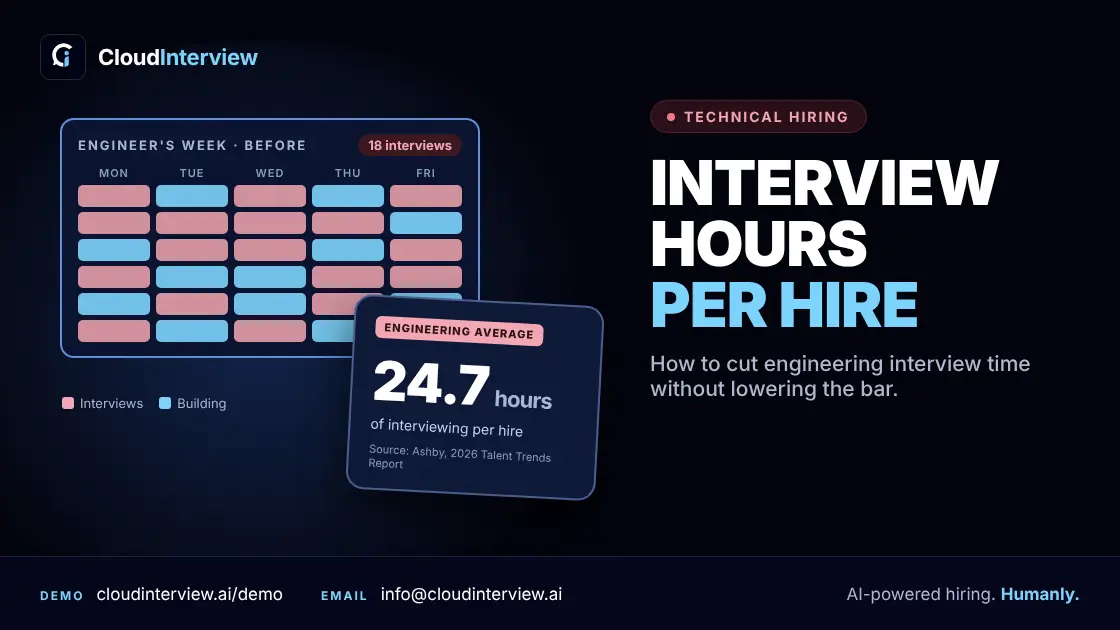
Short answer: interview hours per hire is the total time your team spends interviewing to make one hire. For engineering roles, it averages 24.7 hours per hire, according to Ashby's 2026 Talent Trends Report. That's about double the 12.2 hours for business roles.
You can cut it without lowering the bar. Move the repetitive first round off your engineers' calendars, bring in outside experts when your team is booked, and keep only the final decision in-house.
This guide shows how to measure it, where the hours go, and what to change first.
What is interview hours per hire?
It's one number: how many hours of interviewing it takes your company to make one hire. It counts every interviewer in every round, plus debriefs.
Investors like Lightspeed call it a North Star hiring metric, because every hour spent interviewing is an hour not spent building the product.
The formula:
Interview hours per hire = (candidates in each round × length of the interview × number of interviewers, added up for every round, plus debrief time) ÷ number of hires
Benchmarks: how many hours does an engineering hire take?
| Role type | Average interview hours per hire |
|---|---|
| Engineering | 24.7 hours |
| All technical roles | 23.3 hours |
| Business roles | 12.2 hours |
Source: Ashby, Recruiter Productivity, 2026 Talent Trends Report (data from January 2021 to March 2026).
These are averages. A startup that's hiring fast, with long panels and repeated rounds, can run well above them.
Example: a startup hiring 10 engineers this quarter
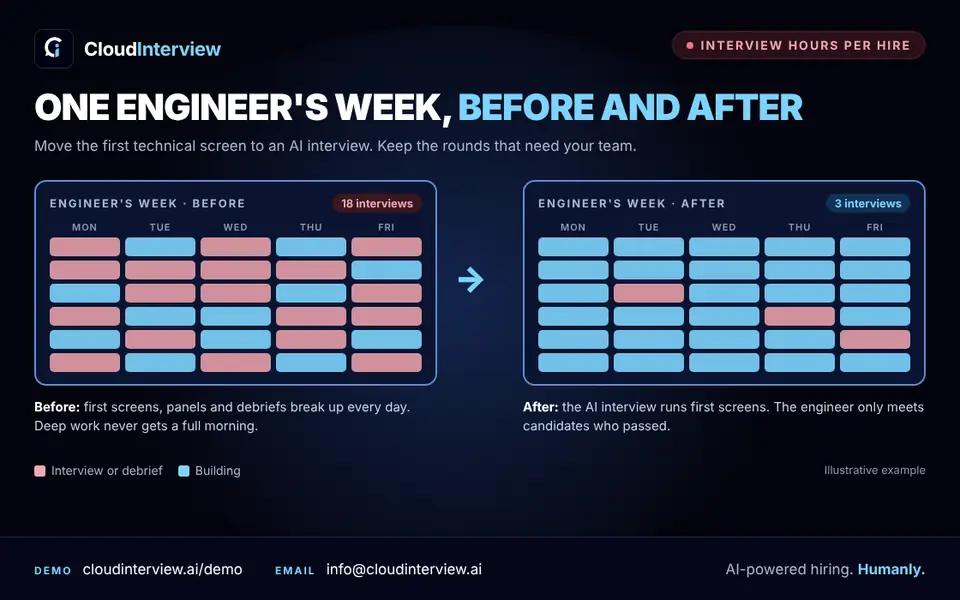
Here's how the hours add up for one engineering hire, using a common process:
- Technical screen: 20 candidates × 1 hour × 1 engineer = 20 hours
- Final panel: 6 candidates × 4 interviews × 1 hour = 24 hours
- Debriefs: 6 candidates × 4 interviewers × 15 minutes = 6 hours
That's 50 engineering hours for one hire. For 10 hires, it's 500 hours, which is more than 12 full work weeks of one engineer's time.
Look at the first technical screen. It costs 20 engineering hours, and most of those 20 candidates won't move forward. That's the easiest place to win time back.
Where engineering interview hours go
- First technical screens. High volume and repetitive. Senior engineers ask the same questions again and again.
- Long final panels. Four or five interviews, often with overlapping questions.
- Debriefs that run long. When interviewers score differently, the team argues instead of deciding.
- Re-interviews. Vague feedback means "let's bring them back for one more round."
5 ways to cut interview hours per hire without lowering the bar
- Measure it first. Track hours by role and by round for one month. You can't cut what you can't see.
- Move the first technical screen off engineers' calendars. An AI interview with live coding and follow-up questions can run this round at any hour, for every candidate. Engineers only see the people who pass. See our guide to automated technical screening.
- Bring in outside experts when your team is booked. During a launch, your engineers can't give up 20 hours a week. Vetted interview engineers can run the technical round on your rubric. Compare the options in interview outsourcing vs in-house panels.
- Use one scorecard for every interviewer. Shared criteria make debriefs short and cut re-interviews. Start with our technical interview scorecard template.
- Drop rounds that don't change decisions. If one round almost never changes the outcome, remove it or merge it with another.
Who should run each round
| Round | Who runs it | Why |
|---|---|---|
| First technical screen | AI interview | Same questions for everyone, any time of day |
| Deep technical round | Your engineers, or outside experts when your team is booked | Needs real expertise and judgment |
| Final round and team fit | Your team | Only your team can judge fit and make the offer |
How CloudInterview helps
- AI Interviews: run the first technical round with live coding, test runs and AI follow-up questions. You get scores, transcripts and recordings for every candidate.
- Interview Outsourcing: vetted human experts run the deep technical round and score it on a structured scorecard, with a recording you can review.
Your engineers keep their time for building, and for the final conversations that only they can have.
Want to see how many hours you could get back? Book a demo or start free.