Interview Outsourcing vs. In-House Panels: Cost, Speed and Control
Should your team run every interview in-house or bring in outside experts? Compare cost, speed, control and quality, and see which rounds to outsource.
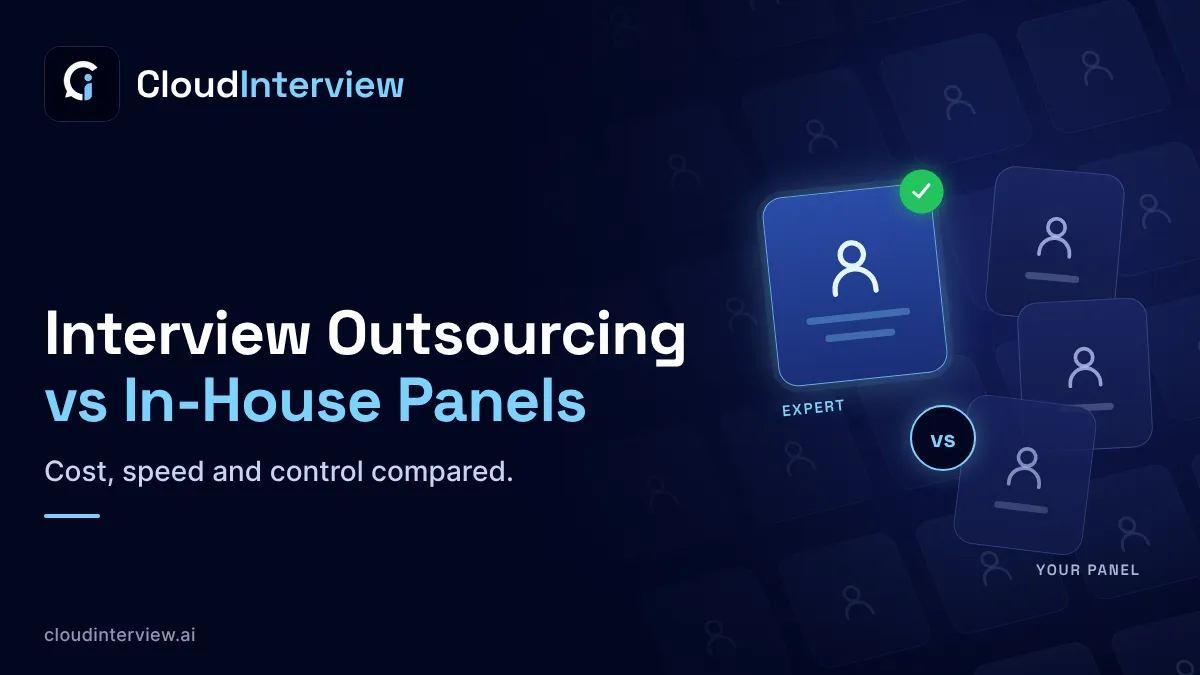
Most hiring teams start with in-house interview panels. Your own people know the role, the team and the hiring bar. But as hiring grows, panels get slow and costly. Senior staff lose hours they should spend on their real work.
Interview outsourcing is the other option. An outside specialist runs the interview and sends you a structured scorecard. You still make the hiring decision.
The short answer: keep final rounds and team-fit rounds in-house. Outsource skills rounds when you hire often, need skills your team lacks, or need interviews this week instead of next month. Most growing teams end up using both.
Interview Outsourcing vs In-House Panels at a Glance
Here is how the two models compare on the factors that matter most.
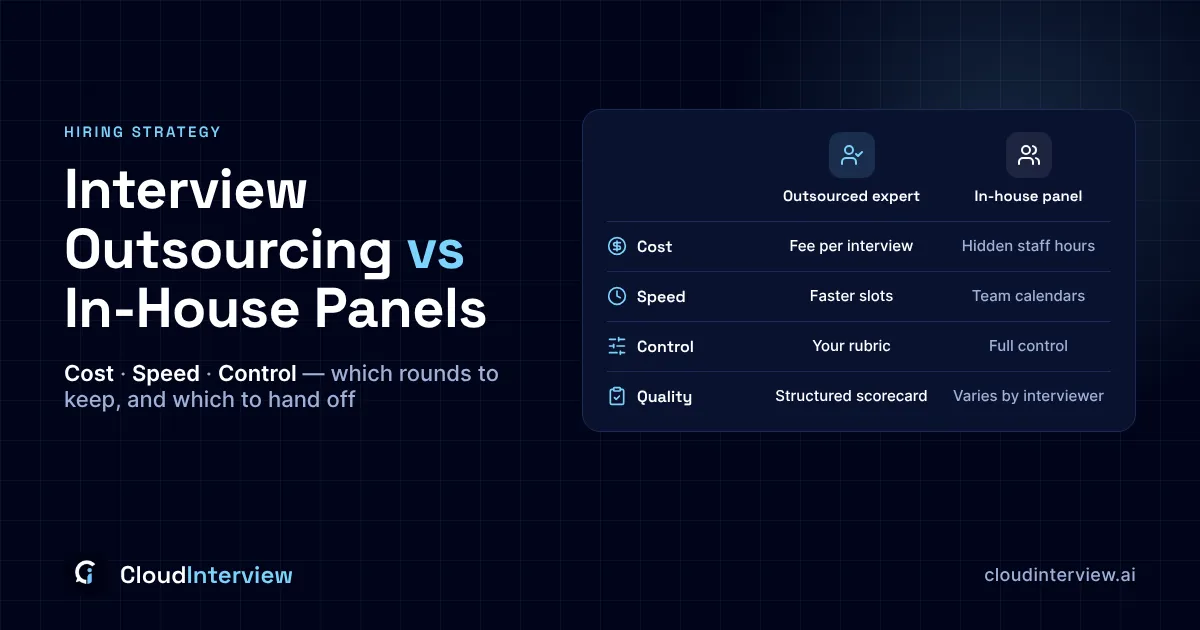
| Factor | In-house panel | Interview outsourcing |
|---|---|---|
| Who interviews | Your own staff, often senior engineers or managers | Outside specialists who work in the field they assess |
| Expertise | Strong in your own stack; gaps in new skills | Matched to the role's skills and level |
| Scheduling | Depends on your team's calendars | Larger interviewer pool, so faster slots |
| Cost | Hidden: staff hours taken from other work | Visible: a fee per interview |
| Control of the hiring bar | Full control | Shared: you set the rubric, the expert applies it |
| Consistency | Varies by interviewer | Same structured rubric for every candidate |
| Candidate experience | Personal, but can be slow | Fast, but less early contact with the team |
| Records | Notes vary by interviewer | Scorecard, and often a recording |
| Best for | Final rounds and team fit | Skills rounds, hiring spikes, niche roles |
What Is Interview Outsourcing?
Interview outsourcing, also called interview as a service or interview process outsourcing, means an outside provider runs some of your interview rounds. You share the role, the skills to test, and the level. The provider matches an interviewer who works in that field. After the round, you get a scorecard with ratings, notes, and a hire or no-hire call.
You keep the final decision. The provider gives you evidence. Your team decides who gets the offer. To see how this works in practice, read about our interview outsourcing service.
Can interviews be outsourced? Yes. Skills rounds are the ones teams outsource most. These include coding, system design, data, cloud, and security rounds. Final rounds and offer talks usually stay in-house.
What an In-House Interview Panel Really Costs
The cost of an in-house panel rarely shows up in a budget. It shows up as lost time.
Use this formula to estimate it:
Panel cost per hire = interviewers per round × hours per interview × candidates interviewed × hourly cost per interviewer
Count prep and write-up time, not just the call.
Example (assumed numbers, swap in your own): Three interviewers spend 1.5 hours each, including prep and feedback. They interview eight candidates for one role. That is 36 hours of staff time for a single hire. If those are senior engineers, the real cost also includes the product work that slips.
Outsourcing turns this into a visible cost: a fee per interview. If you hire rarely, an in-house panel can be the cheaper choice. If you hire often or for senior specialist roles, the gap tends to close or flip once you count lost time.
Speed: How Scheduling Affects Time-to-Hire
In-house panels move at the pace of your busiest interviewer. One full calendar can push a round back a week. Strong candidates may accept other offers while they wait.
Outsourced interview services draw on a larger pool of interviewers, so slots open faster. CloudInterview, for example, offers same-day scheduling through a network of 5,000+ expert interviewers. Speed matters most when you hire in volume or compete for in-demand skills.
Control and Quality: Who Owns the Hiring Bar?
Control is the main reason teams keep interviews in-house. Your team knows the product, the codebase, and the culture.
Outsourcing does not have to mean losing control. Before you start, agree on four things:
- The rubric: which skills are tested and what "strong" looks like
- Your questions: the provider should cover them, not replace them
- The output: a structured scorecard for every candidate
- Review rights: recordings or notes you can check if you disagree
Quality can improve too. In-house interviewers often score the same answer in different ways. A structured rubric, used the same way for every candidate, makes candidates easier to compare. A second opinion adds one more check.
Candidate Experience
Candidates want a fast process, a fair interview, and an interviewer who understands the job.
In-house panels let candidates meet the team, which helps them judge fit. But slow scheduling hurts the experience.
Outsourced rounds are faster and are run by people who do the job. The trade-off is less contact with the future team early on. Fix this by keeping at least one in-house conversation in the process.
Security and Compliance
Outsourcing means sharing candidate data with another company. Check the provider before you start:
- An independent audit, such as SOC 2 Type II
- GDPR compliance and a data processing agreement (DPA)
- Encryption in transit and at rest
- Role-based access and audit logs
- A clear answer on whether your candidate data trains their AI models
See how CloudInterview handles this on our security and compliance page.
When to Keep Interviews In-House and When to Outsource
Keep interviews in-house when:
- You hire only a few people a year
- Your team has the exact skills and the time to interview
- The round tests team fit
- It is the final round or offer conversation
Outsource when:
- Senior staff spend too many hours interviewing
- You need skills your team does not have, such as security or machine learning
- Hiring volume jumps, and calendars cannot keep up
- Interviewers score candidates unevenly
- You need a recorded, documented round for each decision
If three or more of the outsourcing points apply, test interview outsourcing services on your skills rounds first.
The Hybrid Model: AI First, Experts Next, Your Team Last
Many teams now combine all three:
- AI first round: a conversational AI interview screens every applicant on the basics.
- Expert skills round: an outside specialist tests depth and sends a scorecard.
- In-house final round: your team meets a short list and checks fit.
Each step filters the pool, so your team spends time only on the strongest candidates. CloudInterview supports all three steps in one platform.
Hiring engineers? Read our guide to outsourcing technical interviews.
Get expert interviews without building a panel. Book a demo or talk to our team.