Automated Technical Screening: What AI Can Test in a Coding Interview (and What It Can't)
Discover how automated technical screening uses AI interviews, live coding and follow-up questions to vet engineers before your panel, and where a human round still matters.
Automated technical screening uses software, usually an AI interviewer, to test engineering candidates on real coding tasks and technical questions before they reach your interview panel. It replaces the first engineer-led phone screen, so your engineers spend their time only on candidates who have already shown they can do the work.
This guide explains how it works, what it should measure, where it falls short and how to keep it fair.
What is automated technical screening?
Automated technical screening is the first technical round of an engineering hire, run by software instead of an engineer. The candidate solves a coding task and answers technical questions, the software checks the work, and the hiring team gets a score and a recording. Only candidates who pass move on to the human panel.
It usually covers three things:
- Coding: a real task, run against automated tests
- Technical reasoning: questions about how and why the candidate made their choices
- Communication: how clearly the candidate explains their thinking
You will also see it called a technical screening interview, an AI technical interview or an AI coding assessment.
How does AI vet engineers before the panel?
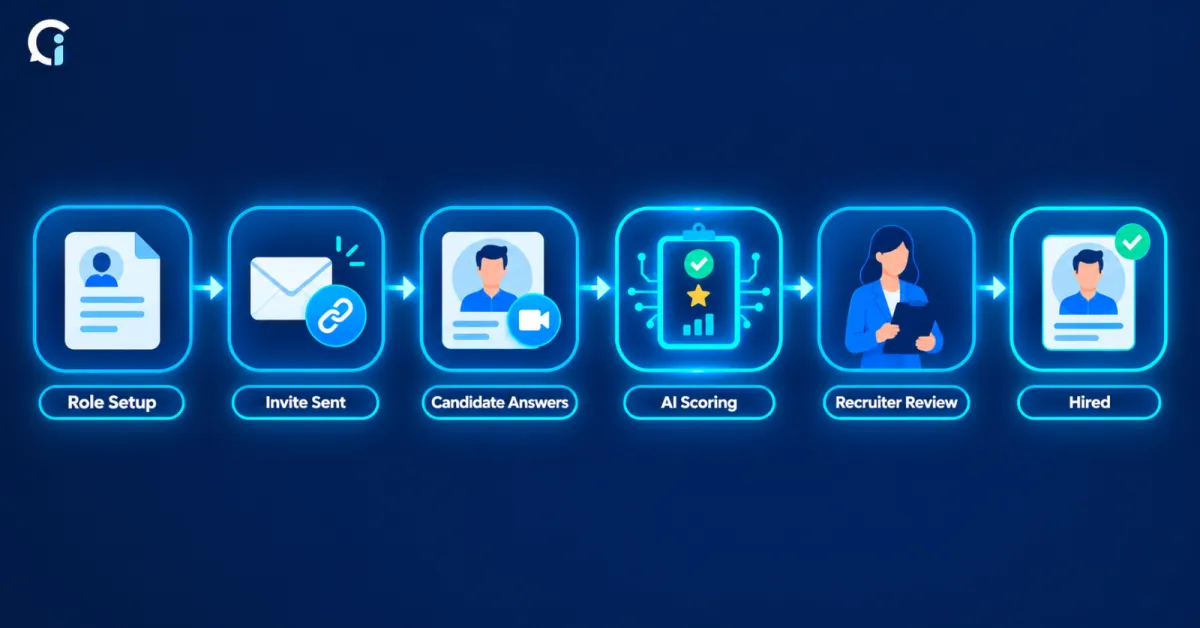
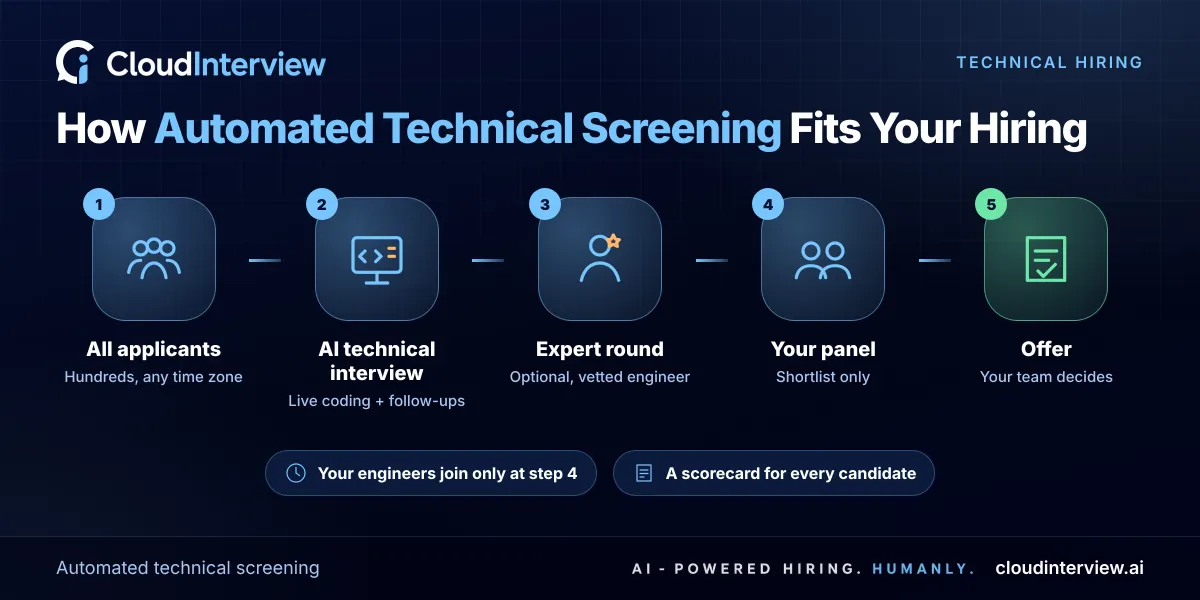
An AI technical interview follows the same steps a good engineer would, but runs them for every applicant at any hour. Most setups follow five steps:
- Build the screen from the job description. Pick the questions, difficulty and programming languages, or let AI draft them from the role.
- The candidate takes it on their own schedule. No engineer needs to be online, so candidates in any time zone can start when they're ready.
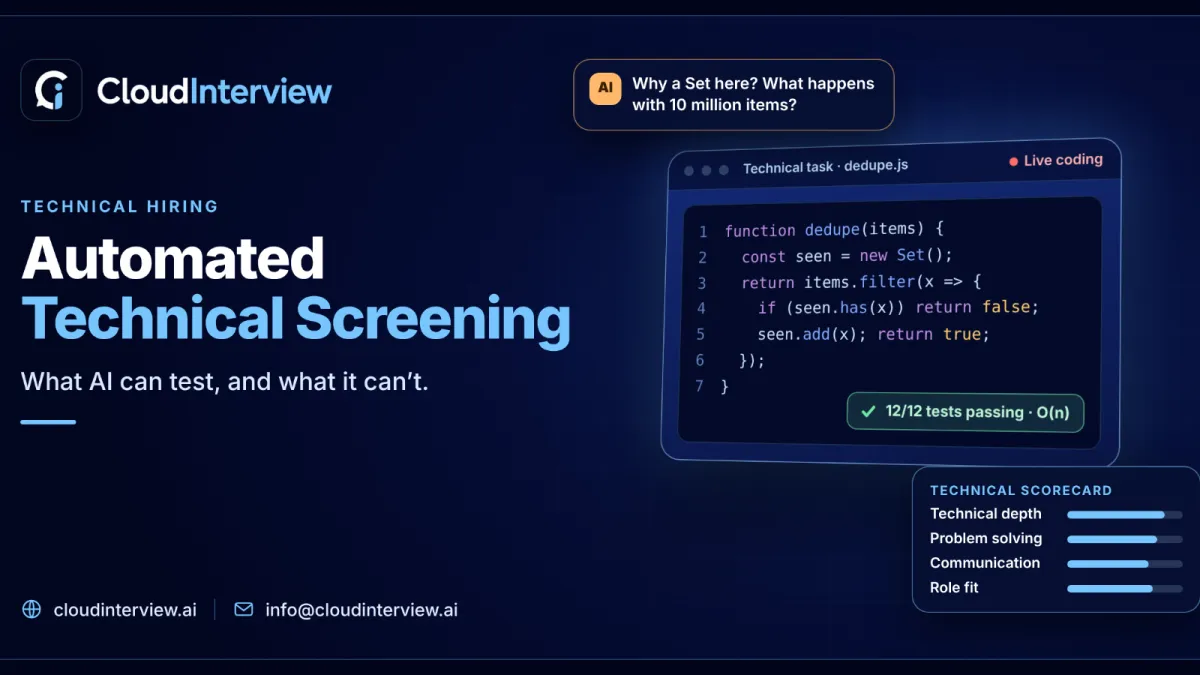
- The candidate solves a coding task. Their code runs against automated tests, so you see which cases pass and how efficient the solution is.
- The AI asks follow-up questions. It asks why the candidate chose that approach, what they would change and how it scales. Strong candidates are pushed further, and weaker answers are probed.
- The team gets a scorecard. Each candidate is rated on technical depth, problem solving, communication and role fit, with a recording and transcript. A person then decides who goes to the panel.
The follow-up questions matter most. A test score shows whether code works. The follow-ups show whether the candidate understands why it works.
How does automated screening compare with take-home tests and live panels?
Automated screening is the fastest way to check coding skill across many candidates. A live panel is still the best way to judge senior judgement and team fit. Most teams use automated screening first and the panel last.
|
Automated technical screening |
Take-home test |
Live engineer screen |
|
|---|---|---|---|
|
Engineer time per candidate |
None until review |
Review time only |
A full interview slot |
|
Candidate time |
Short, one sitting |
Often several hours |
One scheduled call |
|
Scheduling |
None, candidate picks the time |
None |
Needs a shared slot |
|
Checks understanding |
Yes, with follow-up questions |
Only if you discuss it later |
Yes |
|
Consistency |
Same tasks and rubric for everyone |
Depends on the reviewer |
Varies by interviewer |
|
Best for |
First round at volume |
Small, senior-leaning pipelines |
Final rounds and senior hires |
A common setup is an automated screen for every applicant, then a live technical round for the shortlist. That live round can be run by your engineers or by outsourced expert interviewers.
What can AI test in a coding interview?
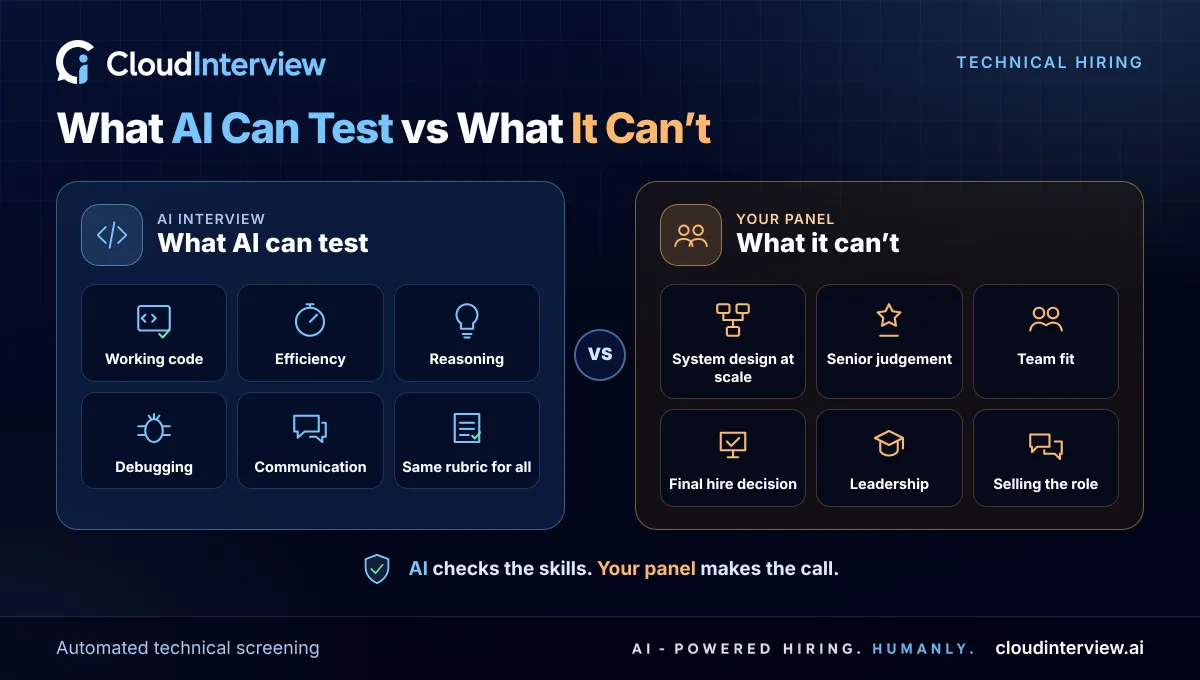
Measure the skills the job uses every week, the same way for every candidate. Same questions and a written rubric make it a structured interview, and a 2022 review of selection research found structured interviews predicted job performance better than any other method it covered.
|
Skill |
How to test it |
What good looks like |
|---|---|---|
|
Working code |
A task close to the real job, run against tests |
Passes the main and edge cases |
|
Efficiency |
Ask about time and memory use |
Can explain the trade-off they chose |
|
Reasoning |
Follow-up questions on their approach |
Explains why, not just what |
|
Debugging |
A short task with a bug to find |
Finds the cause, not just the symptom |
|
Communication |
How they explain their solution |
Clear enough for a teammate to follow |
Skip puzzle questions that have nothing to do with the role. They reward practice more than job skill.
What can't AI test in a technical interview?
It is good at checking skills and weak at judging seniority, judgement and fit. Plan for these limits:
- AI-written answers. Candidates can paste code from AI tools. Follow-up questions about their own code are the best check, because a copied answer is hard to explain. Our guide to stopping fraudulent candidates covers identity checks too.
- Senior roles need more. Architecture decisions and leadership show up in conversation, not in a timed task. Keep a live round for senior hires.
- Not every candidate can take it the same way. Offer more time or another format on request. Under the ADA, employers must provide reasonable accommodations in automated assessments unless that would cause undue hardship.
- Scores need a human check. Treat the AI score as a first pass. Have an engineer review the recording and code before rejecting anyone.
- Rules apply to AI scoring. In Illinois, employers using AI to analyse video interviews must tell candidates first, explain how it works and get consent.
For a full checklist on fairness, see AI interview bias: how to check your hiring tool.
How does CloudInterview run technical screening?
CloudInterview covers both rounds before your panel: an AI technical interview for every applicant, then an optional expert-led round for the shortlist.
|
Round |
What happens |
What your team gets |
|---|---|---|
|
Live coding and technical tasks with automated test runs, plus follow-up questions that adapt to each answer. You pick the questions, difficulty and languages, or AI builds them from the job description. |
A ranked shortlist with scores for technical depth, problem solving, communication and role fit, the reasoning behind each, plus recordings and transcripts |
|
|
A rubric-based interview with a vetted engineer matched to your stack and seniority, often scheduled the same day |
A recorded interview and a detailed scorecard with a hire recommendation |
Results sync into the ATS your team already uses, and you pay for expert interviews per interview. Your engineers join only for the final panel.
Book a demo to see a technical screen for one of your open roles.