AI Interview Scheduling for High-Volume Hiring: Do You Need It?
Scheduling software books 200 interviews. It doesn't remove the 100 interviewers hours behind them. When scheduling is the right fix, and when dropping the schedule works better.
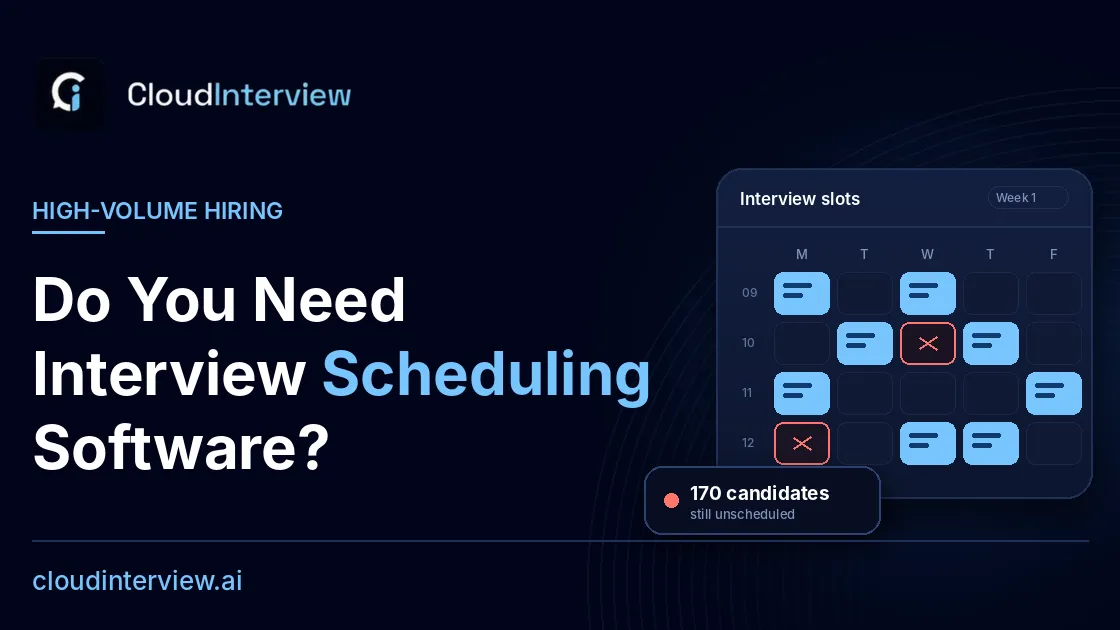
If you are hiring 200 people and shopping for AI interview scheduling software, there is a question worth asking before you buy: why are you scheduling at all?
Scheduling tools solve a real problem. They just solve it one layer too late. This guide covers what the software does, the cost it does not remove, where it still earns its price, and how to structure a high-volume round so you buy less of it.
What does AI interview scheduling software actually do?
It matches two calendars. The software reads candidate availability and interviewer availability, handles time zones, sends the invitation, and manages reminders and reschedules. Better tools write the booking straight into your ATS. The AI part is usually the matching logic and the natural-language handling of replies, not the interview itself.
For a 20-person hiring round, that saves a recruiter a few hours a week and removes a genuinely tedious job. Nobody should be manually coordinating calendars in 2026.
For a 200-person round, the math works out differently and not in the direction the category promises.
Does scheduling software reduce interviewer hours?
No. It reduces coordination hours, which is a different thing. Scheduling 200 first-round interviews still puts 200 slots on somebody's calendar. At 30 minutes each, that is 100 interviewer hours. The software makes those hours easier to book and harder to lose. It does not make them smaller.
This is the distinction that decides whether the purchase helps you. Two different bottlenecks get described with the same words:
- A coordination bottleneck: your recruiter spends their week in email trying to find mutually free slots. Scheduling software fixes this directly.
- A capacity bottleneck: you do not have 100 interviewer hours to give, at any level of coordination efficiency. Scheduling software organises this problem without reducing it.
Most teams hiring at volume have the second one and buy for the first.
There is a second cost that rarely appears in a demo: drop-off. Every scheduling step is a chance to lose a candidate the booking link, the confirmation, the reminder, the reschedule, the no-show. Each step is small. Across 200 candidates they compound, and the candidates most likely to drop are the ones with other offers.
Scheduled interviews vs async: what actually changes?
The difference is whether both people have to be present at the same moment. Scheduled interviews need a shared slot, which creates coordination, time zone handling, reminders and no-shows. Async interviews remove the shared slot, so those four problems stop existing rather than getting managed.
| Stage | Scheduled interview | Async AI interview |
|---|---|---|
| Candidate books a slot | Required | Not needed |
| Interviewer time per candidate | 30 minutes | 0 minutes |
| Time zone handling | A software problem to solve | Does not arise |
| No-shows | Real cost, needs over-booking | Candidate completes or doesn't |
| Rescheduling | Common, often manual | Not applicable |
| Time to first round | Days | Same day |
| Consistency between candidates | Varies by interviewer and time of day | Identical every time |
| Record of the interview | Notes, if anyone took them | Full transcript and scores |
When is interview scheduling software the right tool?
When a human has to be in the room. That is true more often than vendors in either category admit, and the honest answer is that most hiring teams need both tools for different rounds. Scheduling software is the right purchase wherever the value of the conversation depends on a person being present.
Four cases where it earns its price:
- Final rounds. A hiring manager meeting a shortlisted candidate. Always scheduled, always human, and worth coordinating carefully.
- Panel interviews. Four calendars and one candidate is precisely the problem this category was built for. Doing it by hand is painful and error-prone.
- Senior and executive hires. Low volume, high touch. Your bottleneck here is candidate supply, not interviewer hours.
- Roles where you are selling. If the candidate is holding three offers, a human conversation is the product. Do not automate the thing that wins them.
When should you remove the schedule instead?
First-round screening at volume. When the first round is a structured set of questions with follow-ups and a scorecard, nothing about it requires both people present at the same moment. The candidate completes it at 11pm. You read the scorecard the next morning. The coordination problem is not solved — it is absent.
Three signals that you are in this situation:
- Your first round is the same conversation every time. If the questions do not change between candidates, a human is not adding judgment, they are reading a script.
- Candidates are waiting days for a slot. Time to first round is one of the strongest predictors of offer acceptance. If scheduling is adding three days, it is costing you candidates.
- You are rejecting on resumes to control interview volume. This is the expensive one. When the first round is cheap enough to give everyone, you stop filtering on resume formatting and start filtering on answers.
This is what async AI interviews do, and it is why the comparison above matters more than the feature list of any scheduling tool.
What should you look for in AI interview scheduling software?
Look for tools that complete the booking without a human touching it. Many products in this category surface availability and then hand the work back to a recruiter, which removes the typing but not the task. The difference shows up in five specific capabilities worth testing during a trial.
- Calendar write access, not just read. Tools that only read availability still need someone to confirm the slot.
- Bulk invitations. Sending 200 links one at a time defeats the purpose entirely.
- Time zone detection from the candidate's device, not from the job posting's location. This breaks constantly on international pipelines.
- Self-serve rescheduling. If a reschedule request lands in a recruiter's inbox, you have bought a notification system.
- ATS write-back. Interview outcomes belong in your ATS, not in a second dashboard nobody opens.
Ask for a trial on a live role rather than a demo environment. Scheduling tools look identical in a demo and diverge sharply the first time a candidate replies "can we move this?"
How do you structure a 200-candidate hiring round?
Split it by round, and match the tool to what each round actually needs. The goal is to spend human interviewer hours only where human judgment changes the outcome. For most high-volume roles that means an async first round, scheduled second round, and a scheduled final with the hiring manager.
- Round one — async, no scheduling. All 200 candidates get the same structured interview with follow-up questions. Zero interviewer hours, same-day completion, a scorecard for each.
- Round two — scheduled, human. The 25 who scored well. Here scheduling software is worth every rupee, because you are coordinating real people.
- Final — scheduled, hiring manager. The shortlist of five.
You still buy scheduling software. You buy it for 30 interviews instead of 200, and your engineers get their week back. For technical roles where you have no in-house interviewer for round two, you can also outsource the technical round rather than pulling a senior engineer off delivery.
The short version
Buy AI interview scheduling software if your bottleneck is coordinating humans. If your bottleneck is that there are 200 candidates and not enough interviewer hours, scheduling software will organise that problem rather than fix it.
CloudInterview runs conversational AI interviews that candidates complete on their own time, with follow-up questions and scorecards. Book a demo with a real role and see what your first round looks like without a calendar.