Best AI Recruitment Software for High-Volume Hiring (2026 Comparison)
Discover the best AI recruitment software for high-volume hiring in 2026, compared on AI interviews, screening, scheduling and integrations, plus how to pick by bottleneck.
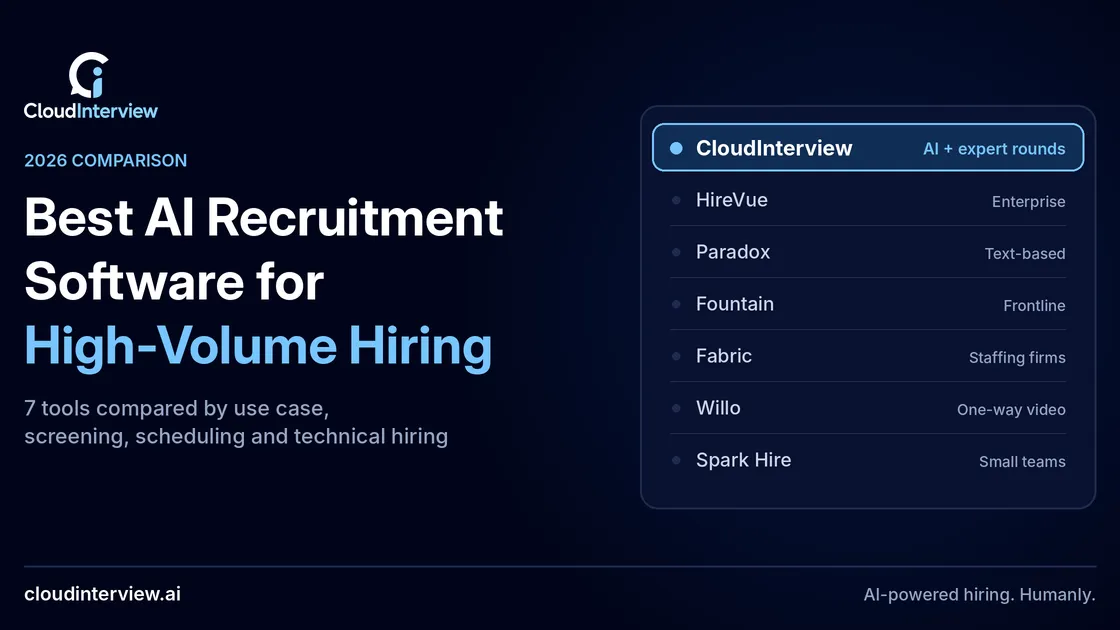
The best AI recruitment software for high-volume hiring depends on where your bottleneck is: first-round interviews, scheduling, or the whole frontline hiring flow. We compared seven tools using each vendor's own website, checked in October 2026.
Quick picks:
- Best for AI interviews plus expert technical rounds: CloudInterview
- Best for large enterprises with assessments: HireVue
- Best for text-based scheduling and conversational hiring: Paradox
- Best for frontline hiring from apply to onboarding: Fountain
- Best for staffing firms and technical sourcing: Fabric
- Best for structured one-way video at volume: Willo
- Best for small and mid-size HR teams: Spark Hire
What is AI recruitment software for high-volume hiring?
AI recruitment software for high-volume hiring automates the repetitive steps that slow down large hiring rounds: screening applicants, running first-round interviews, scheduling and ranking candidates. It lets a small recruiting team keep up with hundreds of applicants per role, while recruiters and hiring managers review the results and make the final decisions.
High-volume hiring breaks in predictable places. Applicants wait days for a callback. Recruiters spend hours on scheduling. First-round interviews vary by interviewer, so scores can't be compared. For technical roles, engineers lose whole days to screening calls.
Each tool in this list targets one or more of those problems. Some screen by phone, some by chat or text, and some by video. For a closer look at the screening step, see our guide to AI candidate screening at scale.
How do the top AI recruiting tools compare?
CloudInterview, HireVue, Paradox, Fountain, Fabric, Willo and Spark Hire all use AI to cut screening time, but they solve different problems. The table below compares them on AI screening, scheduling, technical hiring and public pricing, based on each vendor's own website in October 2026.
| Tool | Best for | AI interviews / screening | Scheduling | Technical hiring | Public pricing |
|---|---|---|---|---|---|
| CloudInterview | AI interviews + expert technical rounds | AI phone screens and video/voice interviews, 24/7 | Same-day expert interviews | Live coding + vetted expert interviewers | Pay per interview (experts) |
| HireVue | Enterprise hiring | 24/7 AI screening interviews | Yes | Technical hiring use case | No |
| Paradox | Conversational, text-based hiring | Chat and SMS screening | Candidate self-scheduling | Not a focus | No |
| Fountain | Frontline hiring end to end | AI recruiter screens candidates | Shift scheduling | Not a focus | No |
| Fabric | Staffing firms and agencies | AI first-round interviews | Not stated | Live coding + cheating detection | No (free trial) |
| Willo | Structured video at volume | On-demand video assessments with AI insights | Not stated | Not a focus | Pay-as-you-go or annual; see pricing page |
| Spark Hire | Small and mid-size teams | AI-enabled one-way video | Interviewer availability sync | Not a focus | See pricing page |
Features are taken from each vendor's own website in October 2026. Check with the vendor before you buy, because products change quickly.
Which AI recruitment software is best for each use case?
Pick by use case. CloudInterview suits teams that need AI interviews plus expert technical rounds. HireVue fits large enterprises that want assessments. Paradox and Fountain lead for hourly and frontline hiring, Fabric for staffing firms, Willo for structured one-way video, and Spark Hire for small HR teams.
1. CloudInterview: best for AI interviews plus expert technical rounds
CloudInterview combines AI screening with human expert interviews. AI Calling runs conversational phone screens 24/7, and AI Interviews run video and voice interviews with adaptive follow-up questions and live coding with automated test runs. For the shortlist, Interview Outsourcing adds vetted engineers who run rubric-based technical rounds, often scheduled the same day.
Strengths: One workflow from screening to expert technical round; scores come with their reasoning, transcripts and recordings; multiple languages and accents.
Consider: Newer to the US market than enterprise suites; no public pricing beyond pay-per-interview for expert rounds.
Best for: Teams hiring at volume, including technical roles, that want AI for scale and human experts for judgement.
2. HireVue: best for large enterprises with assessments
HireVue offers video interviews, job-relevant skills tests and game-based assessments, plus an AI Interviewer for 24/7 screening interviews. Its site lists hourly and high-volume hiring as a use case and describes integrations with 45+ ATS.
Strengths: Broad assessment library; enterprise governance; interview co-pilot for Zoom and Teams.
Consider: Pricing is not public; built for large organisations.
Best for: Enterprises that want assessments and interviews in one platform.
3. Paradox: best for conversational, text-based hiring
Paradox is built around Olivia, an AI assistant that handles screening, interview scheduling and onboarding through chat and SMS. It also runs hiring events and says it detects 100+ languages.
Strengths: Candidates apply and schedule by text; strong for in-person hiring events; integrations with Workday, SAP SuccessFactors and Indeed Apply.
Consider: Focused on conversation and scheduling rather than in-depth interviews or technical assessment.
Best for: Retail, restaurant, franchise and hospitality brands hiring hourly staff.
4. Fountain: best for frontline hiring from apply to onboarding
Fountain covers frontline hiring end to end: sourcing, an ATS, an AI recruiter that screens candidates, shift scheduling and onboarding, including I-9, W-4 and background checks.
Strengths: Covers the whole path from application to day one; built for frontline employers.
Consider: Pricing is not public; less suited to technical or professional roles.
Best for: QSR, retail, logistics and other frontline employers.
5. Fabric: best for staffing firms and technical sourcing
Fabric uses AI agents to source candidates, run first-round AI interviews, including live coding for engineers, and handle outreach by email, WhatsApp and phone. It flags AI-assisted answers with cheating detection.
Strengths: Sourcing and interviewing in one tool; long list of named ATS and CRM integrations, including Bullhorn, Greenhouse, Lever and Workday.
Consider: Pricing not public; geared towards agencies and IT services.
Best for: Staffing firms, recruitment agencies and IT services companies.
6. Willo: best for structured one-way video at volume
Willo lets candidates answer role-specific questions on their own schedule, with AI-assisted transcripts, summaries and insights. It supports 18+ languages and offers identity verification.
Strengths: Accessible candidate experience; named integrations with Greenhouse, Lever, Workday, Ashby, SmartRecruiters and more; pay-as-you-go option.
Consider: Focused on video assessment rather than phone screening or technical interviews.
Best for: Graduate, frontline and high-volume hiring teams.
7. Spark Hire: best for small and mid-size HR teams
Spark Hire combines an ATS with AI-enabled one-way video interviews and a behavioural assessment. It says its ATS integrates with 100+ providers.
Strengths: ATS and video in one place; built for lean HR teams.
Consider: Not aimed at very large hourly hiring programmes or technical assessment.
Best for: Small and mid-size organisations.
How do you choose AI recruitment software for high-volume hiring?
Start with your bottleneck, not the feature list. If managers can't keep up with callbacks, you need screening and scheduling. If engineers are stuck in first-round interviews, you need AI interviews and technical rounds. Match your bottleneck to the tool type below, then shortlist two or three vendors.
| Your bottleneck | What to look for | Tools to shortlist |
|---|---|---|
| Too many applicants to call back | 24/7 AI phone or chat screening | CloudInterview, Paradox, Fountain |
| Scheduling eats recruiter time | Self-scheduling and reminders | Paradox, Fountain |
| Inconsistent first-round interviews | Structured AI interviews with a rubric | CloudInterview, HireVue, Willo |
| Engineers stuck in technical screens | Live coding + expert technical rounds | CloudInterview, Fabric |
| Small team, no ATS yet | ATS with built-in video | Spark Hire |
Most teams have more than one bottleneck. Fix the one that delays hires the most first, then look at the next. For a full buyer's checklist, see what to look for in high-volume hiring software.
What should you check before you sign?
Check five things before you sign: ATS integration by name, the candidate experience on a phone, transparent scoring, human review of every rejection, and a two-week pilot on one live role. Together, these show whether a tool fits your process before you commit to an annual contract.
- Integrations. Confirm the tool connects to your ATS by name, not just "100+ integrations". Ask to see candidate data and scores flow into your ATS during the demo.
- Candidate experience. Take the screen yourself on a phone. If it's slow, confusing or hard to finish, candidates will drop off, and in high-volume hiring that loss adds up fast.
- Transparency. Every score should come with reasoning a recruiter can check. A good AI score works like a technical interview scorecard: the same criteria for every candidate, with evidence behind each rating.
- Human review. A person should approve every rejection. See our guide to AI interview bias for the checks to run on any hiring tool.
- A pilot. Run one high-volume role for two weeks and compare time to shortlist with your current process. Also track how many candidates finish the screen, how many recruiter hours you save, and whether hiring managers agree with the shortlist.
When is AI recruitment software not the right fit?
AI recruitment software pays off when volume is the problem. If you hire a few people a year, have time to interview every applicant, or fill senior roles mainly through referrals and headhunting, a structured interview process and a simple ATS may be enough. Add AI when screening, scheduling or first rounds start delaying hires.
Signs you're ready:
- Qualified applicants wait more than a few days for a first response.
- Recruiters spend more time scheduling than talking to candidates.
- Different interviewers score the same role in different ways.
- Engineers or hiring managers lose several hours a week to first-round screens.
Pilot AI screening on one open role
You don't need to change your whole hiring process to test AI recruitment software. Start with one role that gets the most applicants, run it for two weeks, and compare the results with your current process.
Book a CloudInterview demo to pilot AI screening and expert technical rounds on one of your open roles.