Interview Intelligence Platforms: Do You Need One, or an AI Interviewer?
Interview intelligence makes your interviewers better. An AI interviewer does the interview for you. Here’s how to tell which one you need.
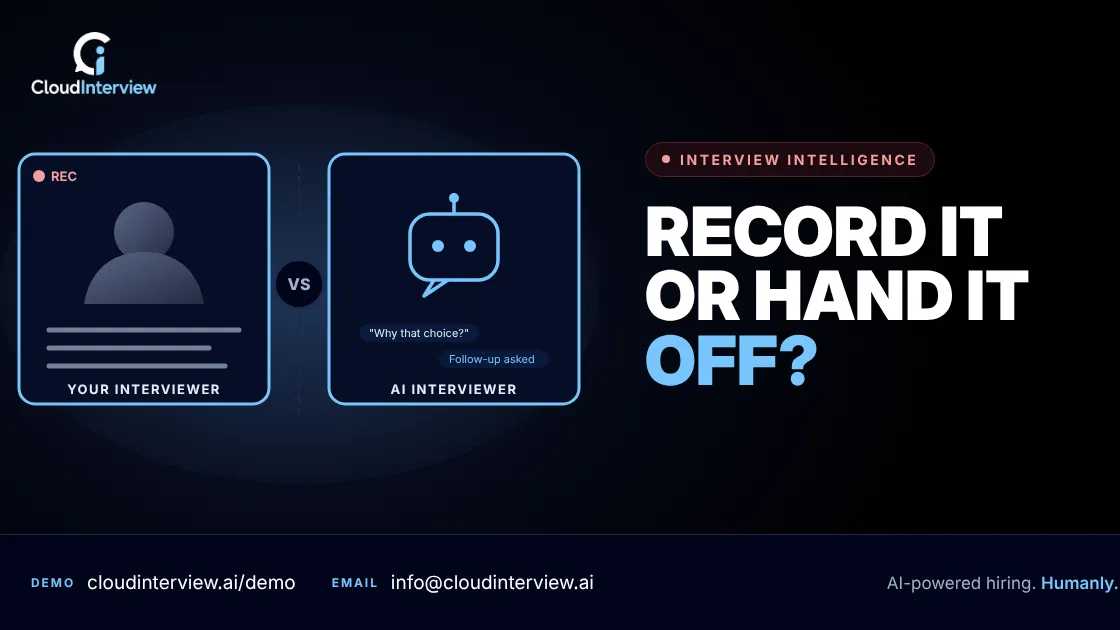
An interview intelligence platform records, transcribes and analyzes the interviews your team already runs. It doesn't interview anyone. People still ask the questions. The software captures what was said, so you can score candidates fairly and coach your interviewers.
That's the key point most buyers miss. Interview intelligence makes your interviewers better. An AI interviewer does the interview for you. They solve different problems. If you buy the wrong one, you'll pay for a tool that doesn't fix what's actually slowing you down.
This guide explains what interview intelligence does, who the main vendors are, how it compares to AI interviewers, and how to pick the right one for a small team.
The short version
- Interview intelligence = recording, transcripts, AI notes and analytics for interviews humans run.
- AI interviewer = software that runs the first interview, asks follow-ups and scores the answers.
- If your problem is messy notes and inconsistent scoring, look at interview intelligence.
- If your problem is not enough interviewer hours, look at an AI interviewer.
- Either way, you need candidate consent to record. Some U.S. states require it from everyone on the call.
What is an interview intelligence platform?
Think of it as a smart note-taker that sits in on your interviews.
According to SocialTalent, these platforms record, transcribe and analyze interviews to support structured hiring. They help human interviewers rather than replace them.
Most platforms do some mix of these jobs:
- Recording and transcripts. The interview is captured (with consent) and turned into searchable text.
- AI notes. The tool writes a summary, so the interviewer can focus on the candidate instead of typing.
- Scorecard prompts. It reminds the interviewer which skills to cover and links scores to the exact moment in the transcript.
- Interviewer analytics. It shows talk time, topics covered and how each interviewer scores compared with the rest of the team.
- ATS sync. Notes and scorecards go straight into your applicant tracking system.
The main interview intelligence vendors
The category has grown fast. Here are some of the names you'll see in the U.S. market:
- BrightHire. Zoom bought it in November 2025. Zoom describes it as an interview intelligence platform that handles recording, transcription and AI-generated notes while people make the hiring decisions (Zoom).
- Metaview. Described as an AI scribe for interviews with clean ATS sync.
- Pillar. Gives interviewers real-time guidance during the interview.
- SocialTalent. Links interview feedback to interviewer training.
(Descriptions of the last three come from SocialTalent's 2026 comparison of interview intelligence platforms. SocialTalent sells one of the tools, so read it with that in mind.)
Notice what all four have in common. A human still runs the interview.
Interview intelligence vs AI interviewer vs one-way video
These three tools often get lumped together. They shouldn't be.
| Interview intelligence | AI interviewer | One-way video | |
|---|---|---|---|
| Who asks the questions? | Your interviewer | The AI | Pre-recorded prompts |
| Follow-up questions? | Yes, if your interviewer asks them | Yes, based on each answer | No |
| Saves interviewer time? | Some (no note-taking) | A lot (no first-round calls) | A lot |
| Main benefit | Better notes, fairer scoring, coaching | Interview every candidate, fast | Screen many candidates fast |
| Main limit | Still needs your team's hours | Needs good questions and human review | Candidates can't be pushed with follow-ups |
| Best for | Teams with enough interviewers | Teams short on interviewer time | Simple, high-volume roles |
If you want to go deeper on the last column, read One-Way Video Interview Software: The Follow-Up Question It Can't Ask.
Which one do you actually need?
Start with your real bottleneck. Ask yourself these three questions.
1. Do we have enough people to run first interviews? If your hiring manager spends 10 hours a week on first-round calls, recording those calls won't give the hours back. An AI interviewer will. If your team has the time, interview intelligence is a good fit.
2. Are our scores consistent? If two interviewers give the same candidate very different scores, you have a consistency problem. Interview intelligence helps you spot it. A shared scorecard helps you fix it. Here's a technical interview scorecard template you can start with.
3. Do we need proof of how we decided? Both tools leave a record. Interview intelligence records your team's interviews. An AI interviewer records the AI's interview and its scoring. Either way, you can show how a decision was made.
A quick rule for small teams: if you hire a handful of people a year and have time to interview, an AI note-taker may be all you need. If you get dozens or hundreds of applicants per role, the bigger win usually comes from not running every first interview yourself.
How to roll out interview recording the right way
Whatever you choose, recording interviews comes with responsibilities. Follow these steps.
- Get consent every time. Tell candidates the interview is recorded, why, and who will see it. Some states require consent from everyone on the call. These include California, Florida, Illinois, Maryland, Michigan, New Hampshire, Pennsylvania and Washington, though the details vary by state (Metaverse Law). This is a quick summary, not legal advice, so check with your lawyer.
- Put consent in writing. Add a line to your interview invite and say it again at the start of the call.
- Use one scorecard per role. Recording a messy interview just gives you a messy recording.
- Score before you read the AI summary. Make your own call first. Then use the notes to check it.
- Decide how long you keep recordings. Write it down and stick to it.
- Review interviewer patterns every quarter. Look for anyone who scores far higher or lower than the rest of the team.
Where CloudInterview fits
CloudInterview isn't an interview intelligence tool. It's built for teams that don't have enough interviewer hours.
- AI Interviews run the first interview for you. The AI asks follow-up questions based on each candidate's answer. Every interview is recorded, transcribed and scored, and you get a ranked shortlist with the reasoning behind each score.
- Interview Outsourcing gives you a live interview with an expert in the role, with a scorecard and a recording. It's useful when nobody on your team can judge a technical answer.
Not sure where AI fits in your process yet? Read What Is an AI Interview? How It Works and When to Use It.
AI for scale. Human experts for judgment.
Fix the right problem
Interview intelligence and AI interviewers are both useful. They just fix different things. If your interviews are inconsistent, record and coach. If you don't have enough hours to interview, hand off the first round.
Book a demo to see how CloudInterview's AI interviews run, record and score the first round for you. AI-powered hiring. Humanly.