Stop Looking for Glitches: How to Catch Deepfake Job Candidates
Glitch-spotting won't stop deepfake job candidates for long. Here's a 90-second check and the questions that expose a fake, whatever the video quality.
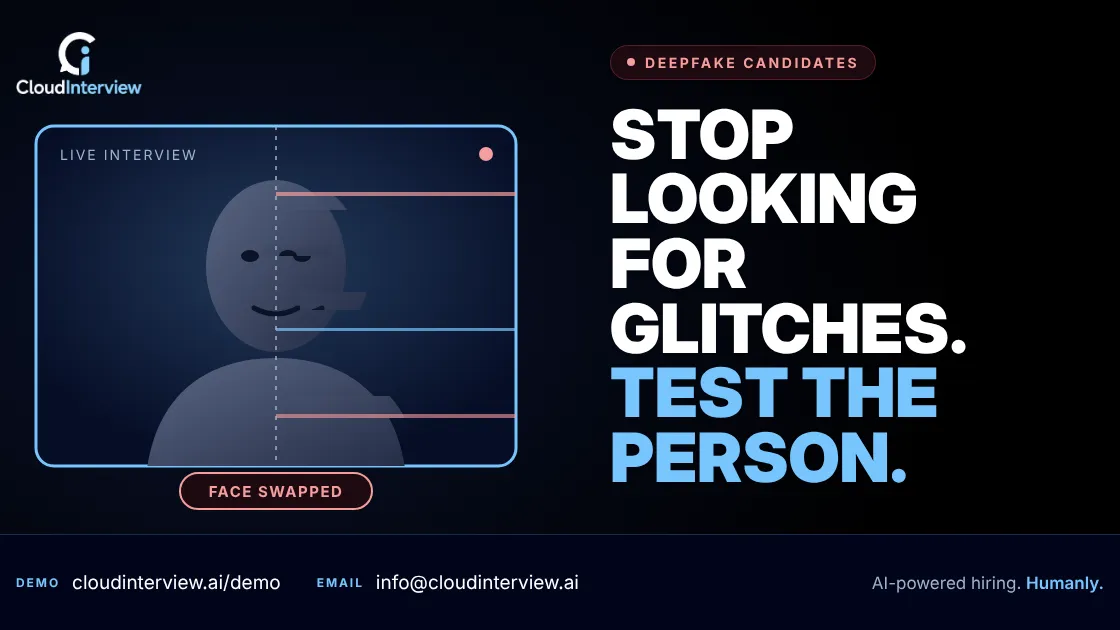
Picture this. You're 20 minutes into a video interview for a remote job. The candidate looks good. They sound confident. They answer every question well. Nothing seems wrong.
That's the problem. A good deepfake doesn't look wrong anymore.
A deepfake is a fake face or voice made with AI. And it's easy to make now. In 2025, a security company called Palo Alto Networks found that someone with no editing skills could build a fake job candidate in about 70 minutes (HR Dive).
U.S. employers are already running into this. In a 2026 survey of 1,500 U.S. managers and business owners, nearly 23% said they may have interviewed a fake or stand-in candidate without knowing it (iprospectcheck).
Most advice says: look for glitches. But here's a better idea. A deepfake can fake a face. It can't fake what someone knows. So don't just watch the video. Test the person.
The short version
- Glitches can help, but they're getting harder to see.
- Use the same 90-second check with every candidate.
- Ask follow-up questions based on what the candidate just said.
- If two or three things feel off, add one more interview with an expert before you make an offer.
In this guide
- Why looking for glitches isn't enough
- What a deepfake can't fake
- The 90-second check
- Follow-up questions to ask, by job
- Real candidate vs faker: what to look for
- No expert on your team? Try this
- What to do if something feels off
- How CloudInterview helps
- FAQs
Why looking for glitches isn't enough
Some fakes still show signs. Back in 2022, the FBI warned that some fake candidates' lips didn't match their voice (FBI).
But glitches have three problems:
- They're going away. Every new deepfake app fixes old mistakes.
- They can fool you. A cheap webcam or slow internet can make an honest person look "off."
- Many fakers don't use a deepfake at all. A real person sits on camera while someone else feeds them the answers.
So use glitches as a clue, not as your test.
What a deepfake can't fake
Think of a deepfake as a mask. A really good one. But the person behind the mask still has to talk, think and remember.
So test these three things:
- What they know: Can they explain their own work in more detail when you ask?
- What they remember: Can they pick up from something they told you earlier?
- How they think: Can they adjust when you change the question?
A real candidate does this easily. A faker, or someone getting help off-screen, will stall, repeat themselves or give a vague answer.
The 90-second check
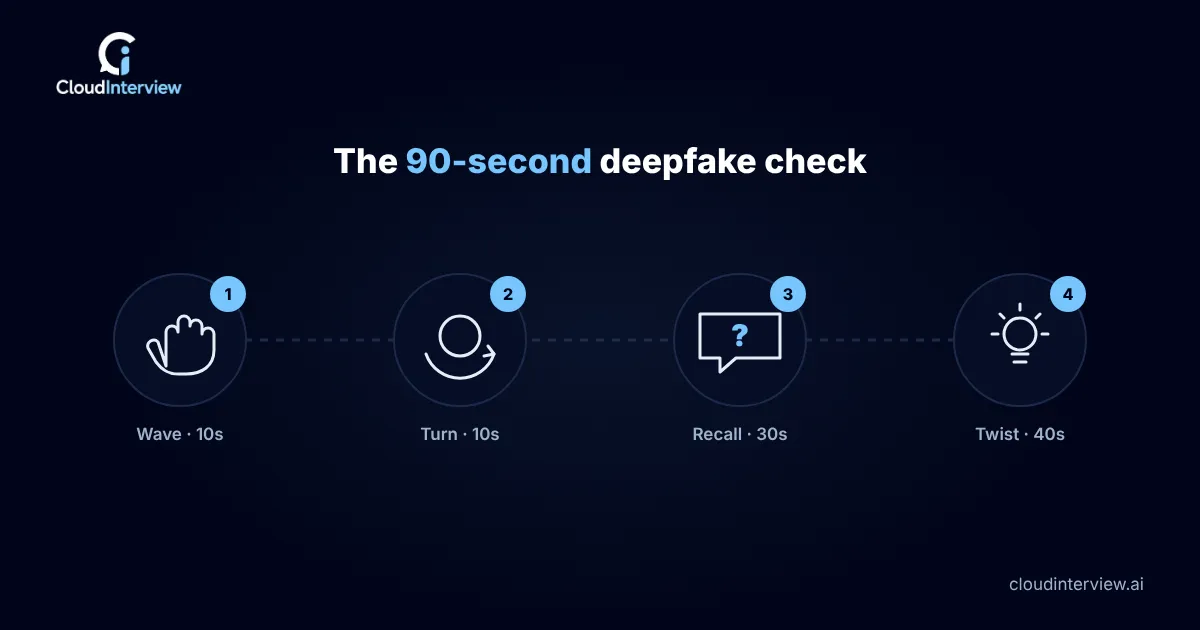
Add this to the middle of any video interview. Keep it relaxed. And do it with every candidate, so nobody feels singled out.
1. Wave (10 seconds)
"Quick thing before we go on: could you wave your hand in front of your face? We do this with everyone."
Many face-swap apps have trouble when something moves in front of the face. Experts suggest this exact check (HR Dive).
2. Turn (10 seconds)
"Thanks! Could you turn to the side for a second?"
A side view is harder to fake than a face looking straight at the camera.
3. Recall (30 seconds)
"Earlier you mentioned [something they said]. What happened next?"
This tests memory, not video. It works even if the deepfake looks perfect.
4. Twist (40 seconds)
"Let's change one thing. If [an option they chose] wasn't possible, what would you do?"
A real candidate thinks out loud. A faker usually pauses for a long time, repeats their last answer or gives a textbook reply.
Tip: Add this line to your interview invite: "Our interviews include a few quick on-camera checks. We do them with every candidate." Honest people won't mind. Fakers might not show up.
Follow-up questions to ask, by job
Anyone can practice "Tell me about yourself." Nobody can practice a question based on what they just told you.
| Job | Start with | Then change it |
|---|---|---|
| Software engineer | "Tell me about a system you built." | "Now traffic triples. What breaks first?" |
| Data analyst | "Tell me about a report you built." | "The main number dropped 20% overnight. What do you check first?" |
| Customer support | "How do you calm down an upset customer?" | "You gave a refund and they're still angry. What now?" |
| Sales | "How do you run a first sales call?" | "The buyer says you cost 30% too much. How do you answer?" |
| Project manager | "Tell me about a project you finished." | "Your lead engineer quits two weeks before launch. What do you do?" |
Real candidate vs faker: what to look for
| Moment | Real candidate | Faker or someone getting help |
|---|---|---|
| A surprise follow-up | Adds new details | Repeats themselves or stays vague |
| "Earlier you said…" | Picks it up easily | Forgets, or the story changes |
| You change the question | Thinks out loud | Long pause, then a perfect-sounding answer |
| Wave or turn | Just does it | Camera "freezes," or they ask to skip it |
One awkward moment means nothing. Everyone has bad days. But two or three together mean it's time to slow down.
No expert on your team? Try this
Here's a common problem for small businesses. Follow-up questions only work if the interviewer understands the job. If you're a founder hiring your first data engineer, it's hard to tell a great answer from a confident one.
You have a few options:
- Ask an expert you know to join the technical interview.
- Pay a contractor for a one-time interview.
- Outsource the technical interview to a specialist who interviews for that job all the time.
What to do if something feels off
- Don't accuse anyone during the call. Finish the interview politely.
- Write down the time of anything that felt strange.
- Compare with earlier interviews. Same face? Same voice? Same level of knowledge?
- Add one more live interview with an expert before you make an offer.
- Check identity the same way for every finalist. Here's how: Your Background Check Passed. So Who Showed Up on Day One?
- Report real fraud to the FBI at ic3.gov.
One rule always applies: never judge someone by their name, accent or where they're from. Judge their answers.
How CloudInterview helps
CloudInterview focuses on the one thing a deepfake can't fake: the conversation.
- AI Interviews ask follow-up questions based on each answer, for every candidate. Each interview is recorded, written up and scored, so you can compare rounds side by side.
- Interview Outsourcing gives you an expert when you don't have one. A specialist in the candidate's field runs a recorded live interview. A real expert asking deep questions is very hard to fool.
Want to learn how stand-ins sneak through between interviews? Read Proxy Interview: 5 Gaps Where Stand-Ins Slip Through.
AI for scale. Human experts for judgment.
Test the person, not the video
Deepfakes will keep getting harder to spot. But no app can give someone knowledge they don't have. Ask the follow-up. Change the question. Compare every interview.
Book a demo to see how CloudInterview's AI interviews ask follow-up questions in real time and record every round. AI-powered hiring. Humanly.