What Is an AI Interview? How It Works & When to Use It
An AI interview lets AI run the first screening conversation and score candidates on set criteria, so recruiters shortlist faster and humans make the final call.
What Is an AI Interview? How It Works, Types, Benefits, and Limits
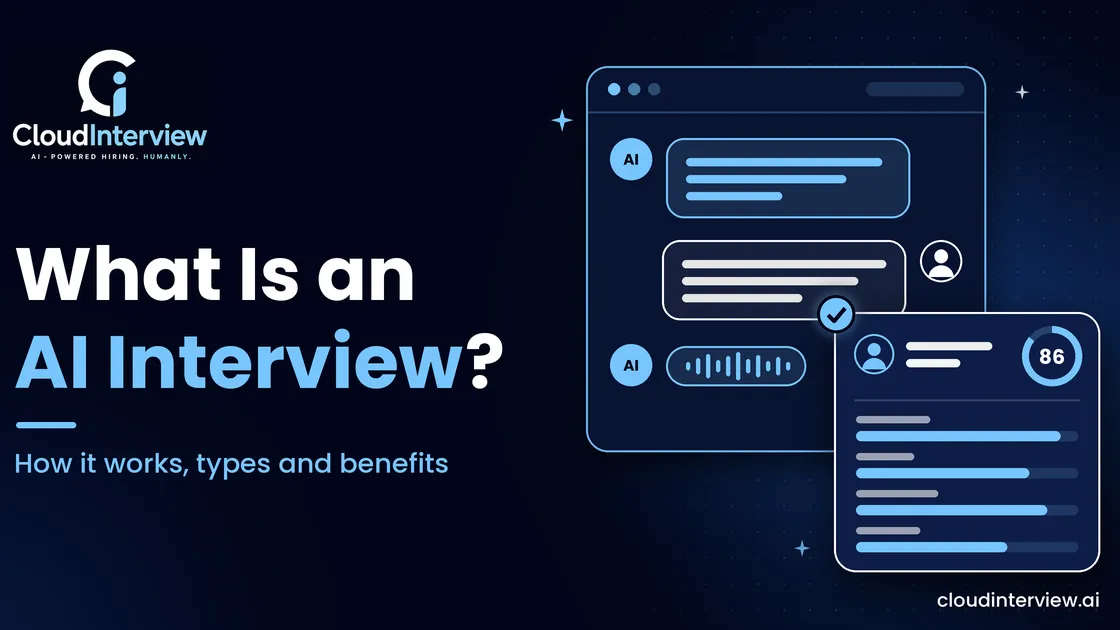
An AI interview is a job interview in which artificial intelligence asks the candidate questions, analyzes the answers, and scores them against criteria the hiring team sets in advance. A recruiter or hiring manager then reviews the results and decides who moves forward.
AI interviews are mostly used at the screening stage, where recruiters face hundreds of applicants for one role and can’t speak to each of them. Instead of a separate phone screen for every applicant, each candidate gets the same structured interview at a time that suits them, and the hiring team gets a consistent shortlist.
How an AI Interview Works
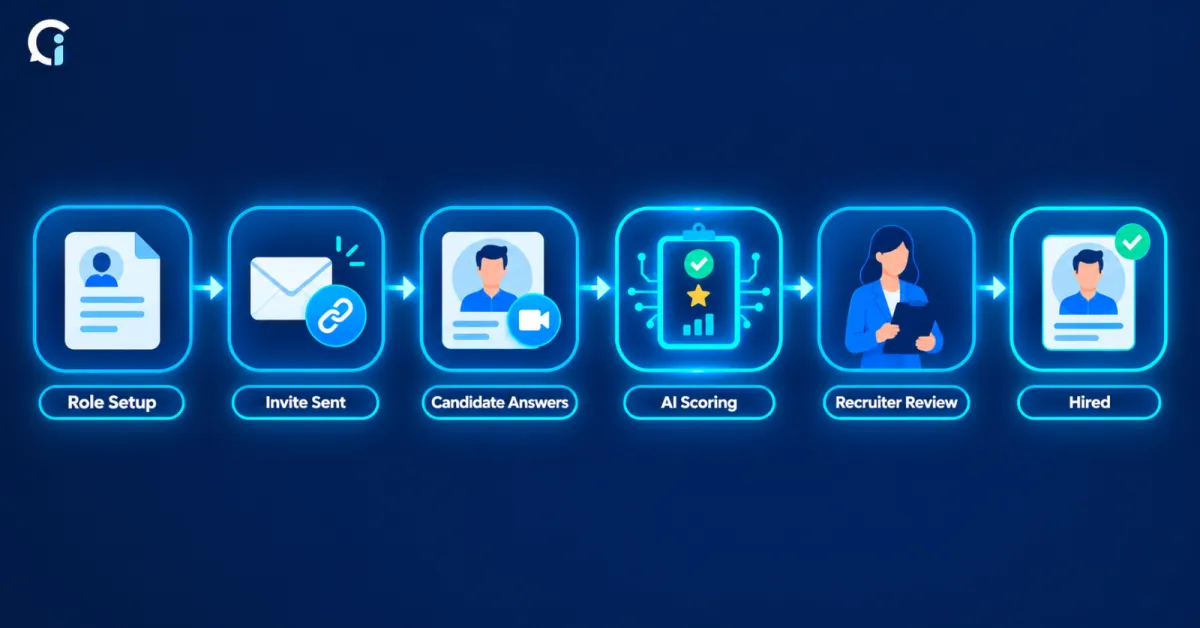
Most AI interviews follow five steps:
- The hiring team sets up the role. Recruiters add the job description, the key skills and the questions to ask, or let the platform suggest questions for the role.
- The candidate gets a link. Candidates join from a laptop or phone, with no back-and-forth over scheduling.
- The AI conducts the interview. In a conversational AI interview, the AI interviewer asks a question, listens to the answer and follows up based on what the candidate said, much like a human screener.
- Answers are evaluated. The platform assesses each response against the role’s criteria, such as relevant experience, technical knowledge and communication.
- The recruiter reviews a scorecard. The hiring team sees a summary, scores for each skill and the transcript, then decides who goes to the next round.
The final hiring decision stays with people. The AI handles the repetitive first conversation, and humans make the judgment call.
Types of AI Interviews
- One-way (asynchronous) video interviews: Candidates record answers to set questions. There are no follow-ups.
- Conversational AI interviews: An AI interviewer holds a two-way conversation, adapts its follow-up questions, and evaluates the full exchange. This is the closest format to a live screening call.
- AI phone screening: A voice AI runs a short qualifying interview over the phone. It’s useful for high-volume and non-desk roles.
- AI coding and technical interviews: The AI asks technical questions or sets coding tasks to assess problem-solving for engineering roles.
AI Interview vs Traditional Phone Screen
| Factor | Phone screen | AI interview |
|---|---|---|
| Scheduling | A slot for every candidate | The candidate joins anytime |
| Consistency | Questions vary by recruiter | The same structured questions for all |
| Recruiter time | Spent on every call | Spent reviewing scorecards |
| Scale | Limited by recruiter hours | Many candidates in parallel |
| Record | Notes vary | A transcript and scores for each candidate |
Benefits for Hiring Teams
- Faster shortlists: Screening runs in parallel, so a role with hundreds of applicants doesn’t wait weeks for first calls.
- Fairer comparison: Every candidate answers the same core questions and is scored on the same criteria. That is the basis of a structured interview.
- Better candidate experience: Candidates interview when it suits them, including evenings, and don’t wait days for a callback.
- More recruiter time for high-value work: Recruiters can focus on final interviews, offers, and relationships.
- Works across regions: Support for multiple languages and accents widens the candidate pool.
Limits and How to Use AI Interviews Responsibly
AI interviews are a screening tool, not a replacement for human judgement.
- Keep humans in the decision. Use AI scores to prioritize candidates, not to auto-reject them without review.
- Check for bias. Review results across candidate groups and remove criteria that don’t relate to the job.
- Be transparent. Tell candidates that an AI is conducting the interview and how the results are used.
- Follow local rules. In the US, New York City’s Local Law 144 and Illinois’s Artificial Intelligence Video Interview Act set notice and audit requirements. Check the rules wherever you hire.
How to Choose an AI Interview Platform
- Does it hold a real conversation with follow-ups, or only record one-way answers?
- Can you customize the questions and scoring for each role?
- Does it support your candidates’ languages and accents?
- Does it give recruiters a clear scorecard and transcript, not just a number?
- Does it work for both technical and non-technical roles?
- Is it priced for your hiring volume, including small teams?
Where CloudInterview Fits
CloudInterview is a conversational AI interview platform for small and growing businesses hiring for IT and non-IT roles. Its AI interviewer runs structured, two-way interviews with follow-up questions. It supports custom questions and workflows, handles multiple languages and accents, and gives recruiters a scorecard for every candidate, so they can shortlist faster without losing strong applicants.
See it in action: Book a demo or sign up.