Technical Interview Outsourcing: Services, Cost and How to Choose the Right Company
Technical interview outsourcing gives you vetted engineers who run your technical rounds and return a structured scorecard, while your team keeps the final decision. Here's how it works, what it costs, and how to choose the right company.
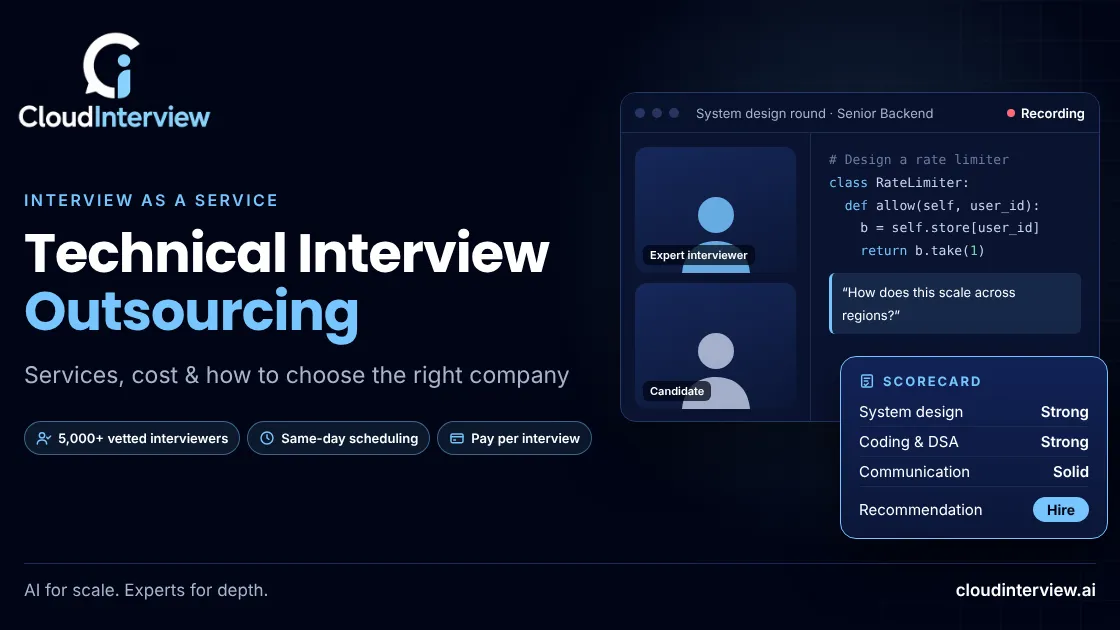
Technical interview outsourcing means a vetted engineer from outside your company runs a technical round, such as live coding, system design or a specialist assessment, and returns a structured scorecard. Your team sets the criteria and makes the final hiring decision. It's also called technical interview as a service: you book interviews on demand instead of building a permanent in-house panel.
At CloudInterview, you share the stack, seniority and focus. A specialist from a network of 5,000+ vetted interviewers is matched, often the same day. The round is recorded and rubric-based, and it ends with a scorecard and a hire recommendation in your dashboard. You pay per interview.
Key takeaways
- Outsource the structured technical round. Keep the final, company-specific round internal.
- The real cost of in-house interviewing is engineering time: roughly 2 hours per candidate once prep, scorecards and debriefs are counted.
- Judge a provider by interviewer match and scorecard quality, not just network size.
- Start with one role as a pilot before rolling it out.
Why Teams Outsource Technical Interviews
At a small company, the founder, engineering manager or a senior developer runs every technical interview. That works with a handful of candidates. As roles open up and applications grow, those same engineers spend their weeks reviewing CVs, running rounds, writing feedback and sitting in debriefs, and hiring starts taking time away from building the product.
Outsourcing selected rounds solves three problems:
- Capacity: hiring comes in surges after a funding round, a large customer or an expansion. External interviewers let you add capacity for the surge and scale back afterwards.
- Expertise: if you're hiring your first cloud security or ML engineer, your current team may not be able to assess every technical detail.
- Consistency: a shared rubric means candidates for the same role are assessed against the same criteria, not whatever each interviewer happened to ask.
Should You Outsource? A Quick Test
Count the hours first.
|
Candidates per role |
Engineering hours (~2 per candidate) |
Roles open |
Total hours |
|
15 |
30 |
3 |
90 |
That's more than two full work weeks of senior engineering time on one hiring push (illustrative figures).
Outsource when: engineers are losing delivery time to interviews, you're hiring outside your team's expertise, or volume swings month to month.
Keep it internal when: the round depends on your proprietary systems or architecture, or it's the final team-fit and decision stage.
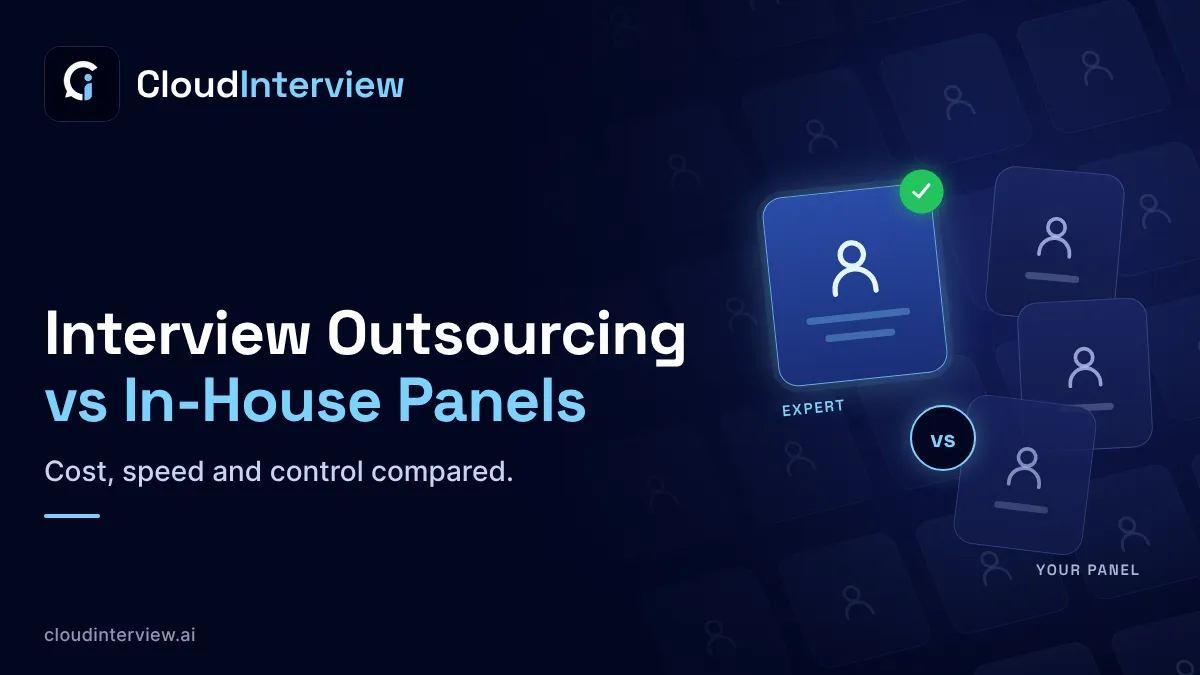
Most teams use a mix: external experts for structured technical rounds, internal leaders for the final round. See Interview Outsourcing vs. In-House Panels for a full comparison.
In-House Panel vs Outsourced Expert vs AI Interview
|
|
In-house panel |
Outsourced expert interviewer |
AI interview |
|
Best for |
Final round, team fit, company-specific systems |
Specialist and senior technical rounds |
High-volume early screening |
|
Depth |
High, with company context |
High, with domain expertise |
Structured, consistent |
|
Speed |
Limited by engineers' calendars |
Often same-day scheduling |
Candidates take it anytime |
|
Cost model |
Engineering time |
Per interview |
Per platform usage |
A practical process uses AI for volume, experts for depth, and your own team for the decision.
How Technical Interview Outsourcing Works at CloudInterview
- Define the role. Share the stack, seniority and assessment focus, or reuse a saved template. Be specific: a senior backend role may need system design, APIs, data modelling and debugging, not just coding.
- Get matched. A specialist who works in that domain is matched to your stack and seniority and scheduled, often the same day.
- Run the interview. A recorded, rubric-based round that covers your questions. Good interviewers watch how the candidate reasons, handles assumptions and reacts when requirements change, not just the final answer.
- Review the scorecard. A detailed scorecard with a hire recommendation lands in your dashboard. Your team makes the final call.
Roles covered include frontend, backend and full-stack, data, AI/ML, mobile, DevOps and cloud, security, QA/SDET, embedded systems, engineering management, product and design.
What a Good Scorecard Looks Like
A pass/fail verdict tells you nothing. An outsourced round should give you evidence:
|
Area |
Rating |
|
System design |
Strong |
|
Coding & DSA |
Strong |
|
Communication |
Solid |
|
Recommendation |
Hire |
Interviewer: Senior Staff Engineer, distributed systems. Illustrative example.
Each rating should explain what the candidate did, where they struggled and why the interviewer scored it that way. Because every CloudInterview round is recorded, your team can review the reasoning before deciding. For a ready-made format, use our technical interview scorecard template.
How Much Does Technical Interview Outsourcing Cost?
CloudInterview prices per interview, with no subscription or seat licence, so cost follows your hiring volume. A quiet month costs nothing; a 40-interview month costs 40 interviews.
What changes the effort behind an interview:
- Seniority: a staff-level system design round goes deeper than a junior coding screen.
- Domain: security, ML and embedded roles need interviewers who do that work daily.
- Format: live coding, system design and architecture review each need a different rubric.
Compare it like this: (engineer hours per candidate × hourly cost × candidates) versus (per-interview price × candidates). Then add the product work those engineering hours would have delivered.
Hiring engineers this month? Get a matched specialist, often the same day, and a recorded, scored interview, paid per interview. Book an interview →
How to Choose a Technical Interview Outsourcing Company
Network size alone tells you little. Ask these questions before you sign up:
|
Ask the provider |
Why it matters |
|
How are interviewers vetted and reviewed? |
A large network is only useful if its interviewers are properly selected and their work is checked |
|
Will the interviewer match our stack and seniority? |
A generalist can't fairly assess a specialist cloud security or ML role |
|
Can we use our own questions and criteria? |
The assessment should reflect your role, not a generic question bank |
|
Can we see a sample scorecard? |
You need evidence behind each rating, not just a score |
|
Are interviews recorded? |
Recordings let your team review decisions and handle disputes |
|
How fast can you schedule? |
Slow scheduling means losing strong candidates to faster offers |
|
How is pricing structured? |
Per-interview pricing keeps cost tied to actual hiring volume |
|
How is candidate data stored and deleted? |
Interviews involve personal data, code and recordings |
CloudInterview's details on data handling are on its Security & Compliance page.
Who Uses Technical Interview Outsourcing
Startups use it to protect a small engineering team's time and to assess specialist hires they can't judge in-house yet.
Scaling tech teams use it to handle hiring surges without permanently pulling senior engineers off delivery.
Staffing and IT recruitment agencies use it to vet candidates before submitting them, so clients don't reject them at the technical round. A typical CloudInterview workflow:
- AI Calling screens every applicant for availability, salary and basics.
- Cloud Test checks core skills automatically.
- AI Interviews run a structured first technical round at volume.
- An expert interviewer assesses the shortlist in the client's stack.
- agency submits each candidate with the scorecard, not just a CV.
Illustrative funnel: 300 applicants → 60 after AI Calling → 20 after AI Interview → 8 expert-vetted submissions.
Pitfalls to Avoid
- Generic interviews. If backend, cloud and data candidates all get similar questions, the feedback says little about fit for the actual job.
- Scores without evidence. Your team needs to see why a candidate was rated the way they were.
- Poor candidate experience. Candidates expect a relevant, professional interview that respects their time. It reflects on your company, not the provider.
- Remote interview fraud. Proxy candidates and off-screen help are real risks. Recorded sessions give you an audit trail, and live follow-ups (changing a constraint mid-problem, or asking "why this data structure?") expose memorised or assisted answers far faster than a take-home test. Read more on AI candidate fraud.
Start With a Pilot
You don't need to outsource every role at once. Pick one role, define the competencies, run a small batch of outsourced interviews, and review:
- Time from request to completed interview
- Scorecard quality and how useful your reviewers found it
- Candidate feedback
- How outsourced-assessed candidates performed in later rounds
An external interviewer won't always reach the same recommendation as your team, but your team should always be able to see how they reached it.
Build Interview Capacity Without Bottlenecks
Technical interview outsourcing is more than handing someone a video call. With clear role requirements and evidence-based scorecards, it lets you add interview capacity on demand, protect your engineers' time and assess skills you don't yet have in-house.
CloudInterview brings together AI Calling, AI Interviews and technical interview outsourcing services, so you can choose the right support for each hiring stage.
Ready to free up your engineers? Book an interview with CloudInterview and get your first scorecard, often within the same day.