One-Way Video Interview Software: The Follow-Up Question It Can't Ask
One-way video interview software fixed scheduling but can't ask a follow-up. Compare it with AI interviews, see the review-time math and 8 vendor questions.
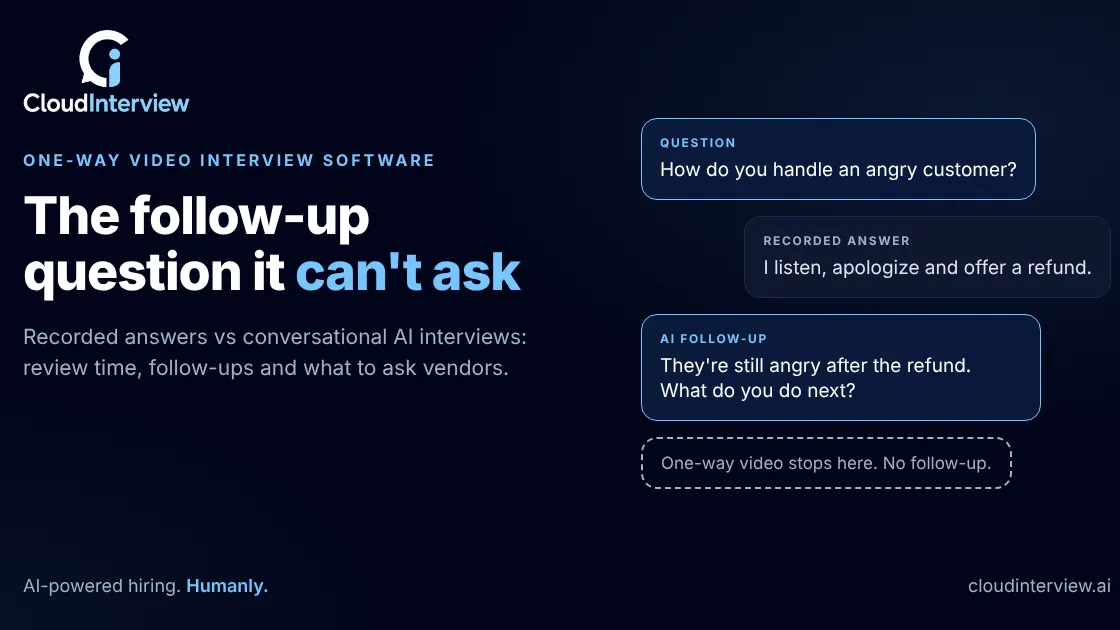
One-way video interview software solved a real problem: scheduling. Candidates record answers when it suits them, and nobody has to find a shared slot. But it left a bigger problem in place. A recorded answer can't be questioned. When a candidate gives a vague answer, nobody asks "why?" or "what would you do differently?", and those follow-ups are where most hiring judgment happens.
This guide compares one-way video interview software with conversational AI interviews. It covers the review time each one leaves your team with, the follow-up questions a recording can't ask, the laws to check before you buy, and 8 questions to put to any vendor.
In this guide
- What one-way video interview software does
- The review-time math
- One-way video vs conversational AI vs a live expert round
- Follow-up questions a recording can't ask
- When one-way video interview software is still the right choice
- Do one-way video interviews work for senior roles?
- Laws to check before you buy
- 8 questions to ask any vendor
- FAQs
What one-way video interview software does
One-way video interview software, also called asynchronous or pre-recorded video interviewing, sends candidates a set of fixed questions. Each candidate records an answer to every question, usually with a time limit and a retake rule. Recruiters and hiring managers watch the recordings later and rate them.
It works well for removing scheduling back-and-forth. It does not change what happens after the recording: a person still has to watch, judge and compare every answer. For a fuller explainer, see What Is an Asynchronous (One-Way) Interview?
The review-time math
Most teams underestimate how much video one-way interviews create. Here is a simple example with typical settings.
| Setting | Example value |
|---|---|
| Candidates invited per role | 100 |
| Questions per interview | 5 |
| Average answer length | 2 minutes |
| Total video to review | 1,000 minutes, about 16.7 hours |
Faster playback and skipping help, but someone still watches hours of answers to a script that never adapted to the candidate. The software moved the work from the calendar to the review queue. It did not remove it.
One-way video vs conversational AI vs a live expert round
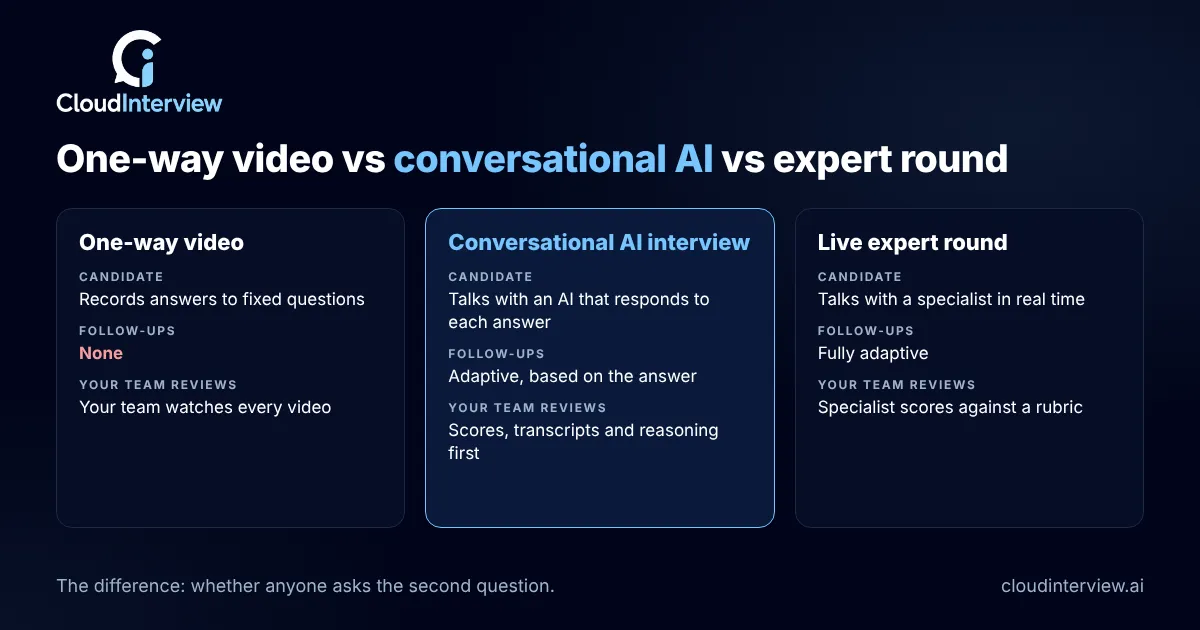
| One-way video interview software | Conversational AI interview | Live expert round | |
|---|---|---|---|
| What the candidate does | Records answers to fixed questions | Talks with an AI interviewer that responds to each answer | Talks with a specialist in real time |
| Follow-up questions | None | Adaptive follow-ups based on the answer | Fully adaptive |
| Who reviews | Your team watches every video | Your team reads scores, transcripts and reasoning, then watches selected moments | The specialist scores against a rubric |
| Output | Recordings plus your team's ratings | Scores, transcripts, recordings and a ranked shortlist | A scorecard with a hire recommendation |
| Best for | Simple screening at volume | First-round screening where depth matters | Final technical or specialist judgment |
The real difference is not video versus AI. It is whether anyone asks the second question.
Follow-up questions a recording can't ask
A strong first answer tells you a candidate prepared. The follow-up tells you whether they can think. Here are examples for both technical and non-technical roles.
| Role | First question (one-way can ask this) | Follow-up (one-way can't) |
|---|---|---|
| Customer support | "How do you handle an angry customer?" | "You offered a refund and they're still angry. What do you do next?" |
| Sales | "Walk me through how you run a discovery call." | "The buyer says your price is 30% too high. Respond as you would on the call." |
| Retail shift lead | "How do you plan a shift?" | "Two people call in sick an hour before opening. What changes?" |
| Backend developer | "Describe a system you designed." | "Traffic triples every morning at 9 a.m. What breaks first?" |
| Data analyst | "Tell me about a dashboard you built." | "The numbers dropped 20% overnight. What do you check first?" |
Each follow-up depends on the first answer, so it can't be written in advance. Conversational AI interviews and live interviewers can ask it. A recording can't.
When one-way video interview software is still the right choice
One-way video interview software is a fair choice when:
- The role has simple, clear criteria, such as availability, location or basic communication.
- You need candidates to show presence on camera, for example in front-desk roles.
- Your team has time to watch every recording, and volume is modest.
- You want a fixed, identical question set for every candidate and nothing more.
If any of these is untrue, or if you're hiring for skills that need probing, the missing follow-up costs you more than the scheduling saves.
Do one-way video interviews work for senior roles?
Usually not as the main assessment. Senior candidates are often more willing to talk with a person than to record answers to a script. Their value also shows in trade-offs and judgment, which only come out in follow-up questions.
If you use one-way video for senior roles, keep it to logistics: notice period, location, motivation. Move the real assessment to a live round. For technical roles, a structured expert round with a scorecard works better than any recorded format.
Laws to check before you buy
If your software uses AI to evaluate video interviews, U.S. rules may apply. Two examples:
- Illinois: The Artificial Intelligence Video Interview Act requires employers who use AI to analyze video interviews for Illinois-based roles to notify applicants beforehand, explain how the AI works and what it evaluates, and get consent. Employers may not use AI to evaluate applicants who have not consented.
- New York City: Local Law 144 requires an automated employment decision tool to have a bias audit within one year of use, a public summary of the results, and notice to candidates. Enforcement began on July 5, 2023.
Ask any vendor how its product supports these steps. This is a summary, not legal advice, so check your own obligations with counsel.
8 questions to ask any vendor
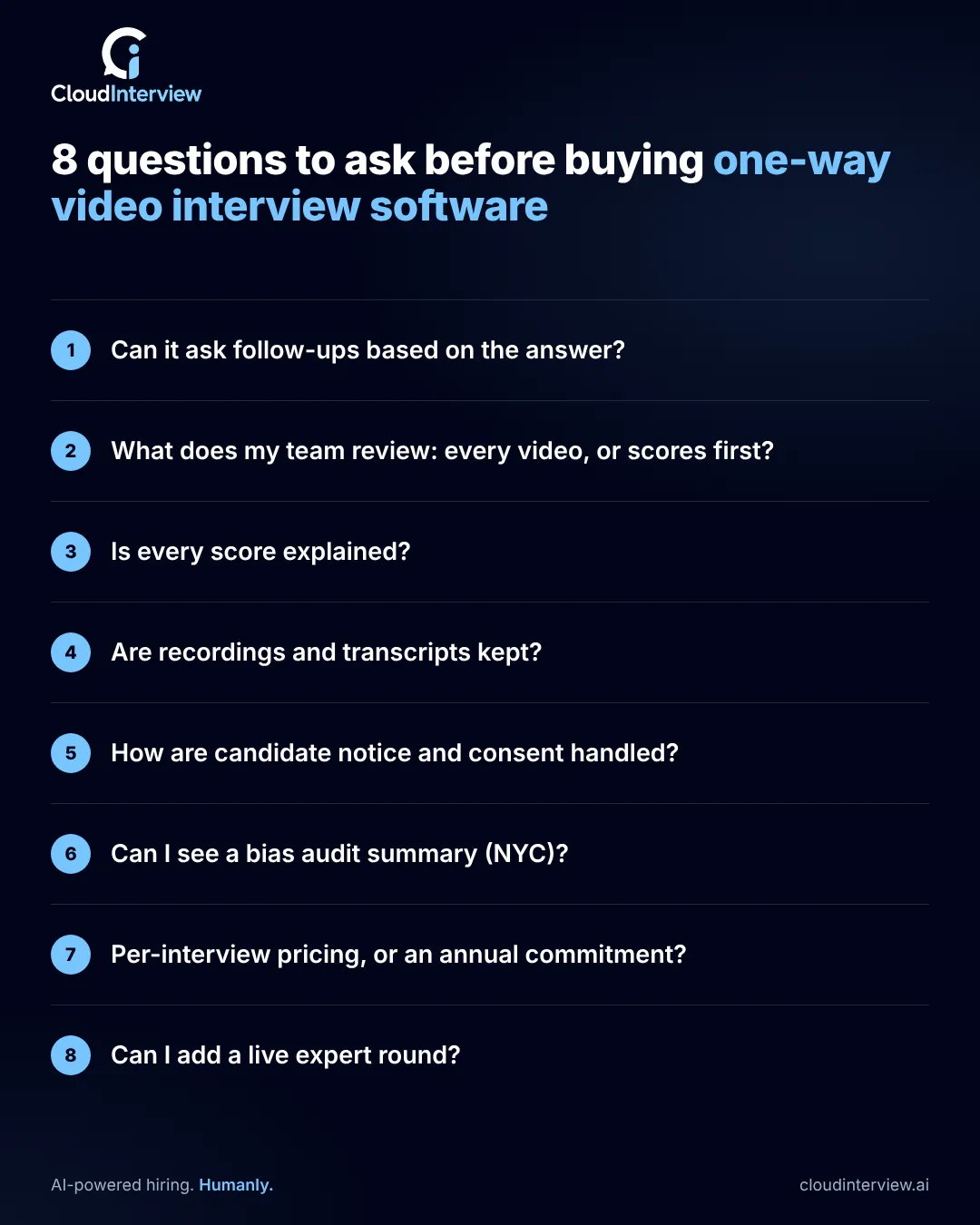
- Can it ask follow-up questions based on the candidate's answer? Or only fixed ones?
- What does my team review? Every video, or scores and transcripts first?
- Is every score explained? Can I see the reasoning behind it?
- Are recordings and transcripts kept for audit and comparison across rounds? This also helps you catch proxy interviews.
- How are candidate notice and consent handled before an AI evaluation?
- Can I see a bias audit summary, if hiring in New York City?
- How is it priced? Per interview, or an annual seat or volume commitment?
- Can I add a live expert round for shortlisted candidates in the same workflow?
How CloudInterview approaches this
CloudInterview was built around the second question. AI Interviews run video and voice interviews with adaptive follow-ups, then give your team scores, transcripts, recordings and reasoning, plus a ranked shortlist. For phone-first roles, AI Calling runs structured screening calls. When a role needs specialist judgment, Interview Outsourcing adds a recorded, rubric-based round with a matched expert.
AI for scale. Human experts for judgment.
Ask the second question
One-way video interview software fixed scheduling, but hiring decisions depend on follow-ups. If your roles need judgment, choose a format that can ask "why?"
Book a demo to see a CloudInterview AI interview ask follow-ups in real time. AI-powered hiring. Humanly.