Proxy Interview: 5 Gaps Where Stand-Ins Slip Through Technical Hiring
A proxy interview beats the gaps between hiring rounds, not a single check. Here are the 5 gaps, a continuity test and follow-up questions by role that expose a stand-in.
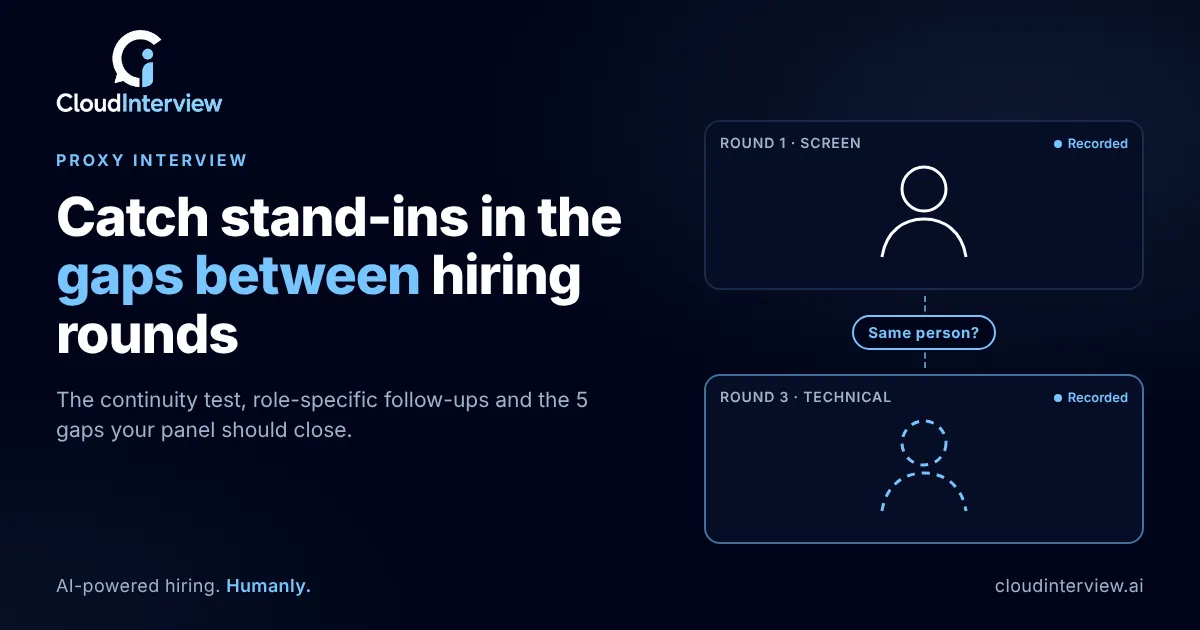
Most advice on the proxy interview says the same thing: check the ID and watch for lip-sync problems. That helps, but it misses how a proxy interview usually succeeds. The stand-in rarely beats a single check. They beat the gaps between rounds, where nobody compares the person in round three with the person in round one.
This guide maps those gaps in a technical hiring process. It also gives you a continuity test, follow-up questions by role, and a table that tells your panel what to do when something feels off.
In this guide
- A proxy interview in one paragraph
- The 5 gaps where a proxy interview slips through
- The continuity test: make every round build on the last
- Follow-up questions that break a stand-in, by role
- Proxy interviewing signals and what to do next
- Why AI-only screening misses the hand-off
- A candidate notice you can copy
- FAQs
A proxy interview in one paragraph
In a proxy interview, someone other than the real applicant answers for them. That can be a stand-in on camera, a helper feeding answers off-screen, or a skilled person who passes the rounds for someone else who then starts the job. In a Gartner survey of 3,000 candidates, 6% admitted to interview fraud, including having someone stand in for them. The FBI and the U.S. Department of Justice have both named remote IT and software roles as a target.
Proxy interviewing is one form of interview cheating. Its newer cousins are deepfake face swaps and real-time AI interview assistants, and the checks in this guide help with all three.
The 5 gaps where a proxy interview slips through
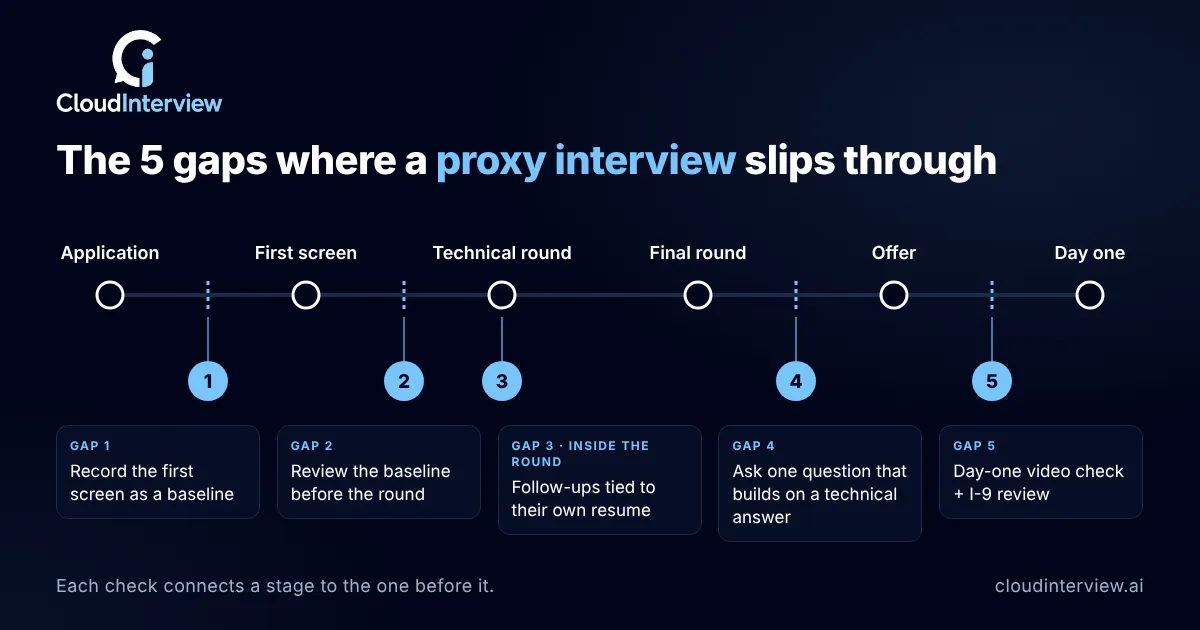
Every hand-off between stages is a chance to swap the person. Here is where it happens, and what closes each gap without slowing honest candidates down.
| Gap | What the stand-in exploits | Check that closes it | Friction for honest candidates |
|---|---|---|---|
| 1. Application to first screen | Nobody has seen the applicant's face yet, so any face can show up | Capture a recording of the first screen to use as a baseline | Low |
| 2. First screen to technical round | Different interviewers, no shared notes, so a new face goes unnoticed | Interviewer watches 2 minutes of the baseline before the round | Low |
| 3. Inside the technical round | Questions are standard, so a helper can answer from off-screen | Follow-ups tied to this candidate's own resume and earlier answers | Low |
| 4. Final round to offer | The person on the offer call is never compared with the technical round | Ask one question that builds on a technical-round answer | Low |
| 5. Offer to day one | The person who starts work is not the person who interviewed | Day-one video check against the recordings, plus the Form I-9 document review U.S. employers already do | Low |
None of these checks is heavy monitoring. Each one simply connects a stage to the one before it.
The continuity test: make every round build on the last
The continuity test is simple. Each round carries two facts forward, and the next round asks the candidate to build on them. A real candidate does this easily because they were there. A stand-in or a fresh helper has to guess.
How to run it:
- At the end of each round, the interviewer notes two specific things the candidate said. For example: "chose PostgreSQL over MongoDB for the orders service" and "hit a deadlock in the payments job last year".
- At the start of the next round, the new interviewer opens with one of them: "In your last round you mentioned a deadlock in a payments job. What was holding the lock?"
- Compare tone and detail. A real candidate adds new detail. A swapped person repeats the summary or changes the story.
- Compare the recordings if the answer feels thin. Same face, same voice, same way of explaining.
The test costs nothing and feels like a normal conversation to honest candidates.
Follow-up questions that break a stand-in, by role
A helper off-screen can handle a standard question. They struggle with questions that depend on what this candidate built, or that change halfway through. Use these as starting points.
| Role | Follow-up question | Why a stand-in struggles |
|---|---|---|
| Backend | "Your design uses a queue between orders and billing. Traffic now triples every day at 9 a.m. What fails first, and what do you change?" | The answer has to extend a design made minutes ago, in real time |
| Frontend | "Keep the component you just built, but it must now work offline. Walk me through the first three changes." | A constraint change mid-task breaks prepared answers |
| Data | "Your resume says you halved a pipeline's runtime. Which step was slowest before, and how did you find it?" | Only the person who did the work knows the debugging path |
| DevOps / Cloud | "Think of the last incident you were paged for. What was the first command you ran?" | Specific memory, not a textbook answer |
| Any role | "Explain your last answer to a product manager who doesn't code." | A relayed answer is hard to re-explain in new words fast |
To keep these fair across candidates, add them to a structured technical scorecard so every candidate for the role gets the same type of follow-up.
Proxy interviewing signals and what to do next
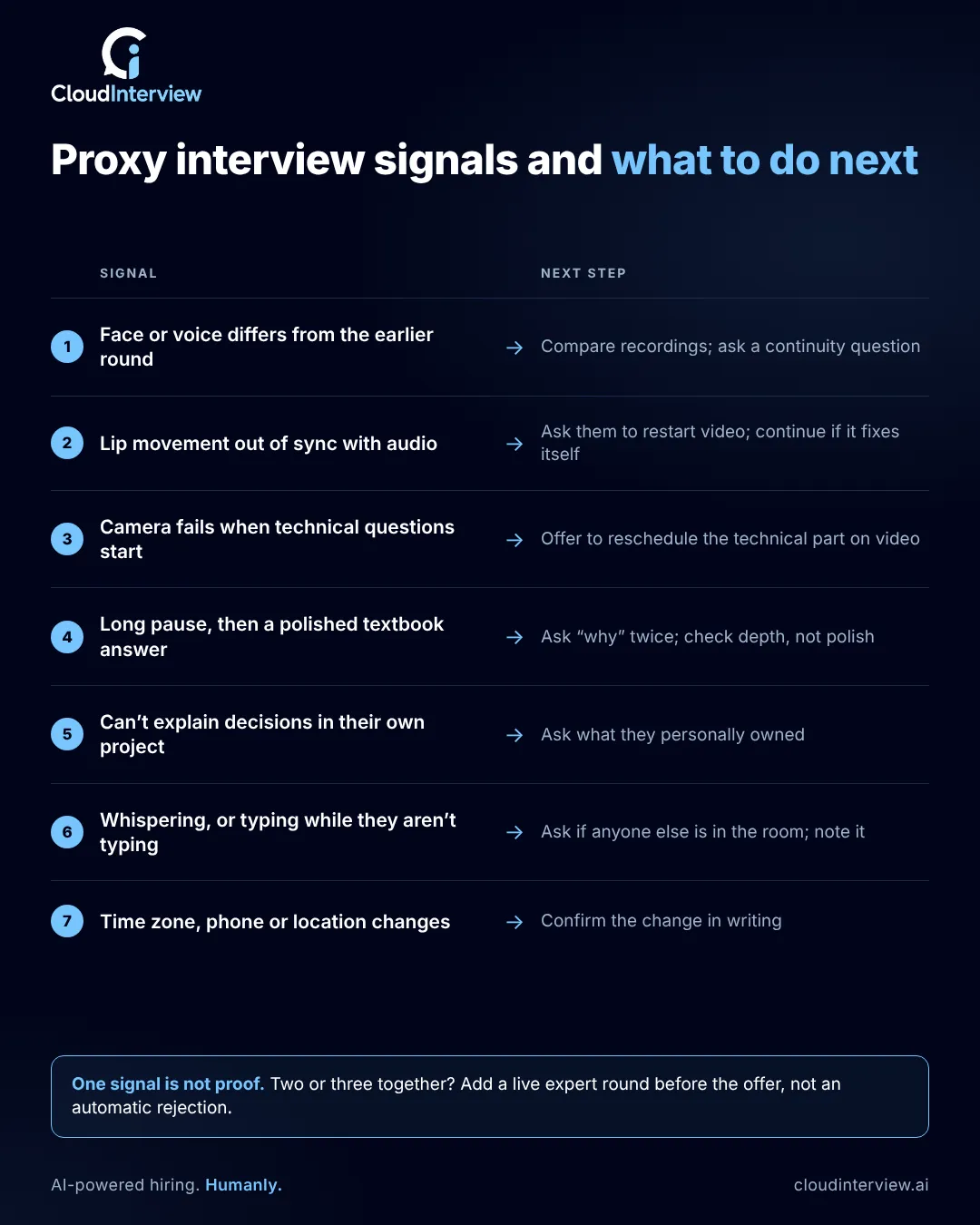
One odd moment is not proof. Nerves, poor Wi-Fi and accents explain a lot. The table below pairs each proxy interview signal with an innocent cause and a proportionate next step.
| Signal | Innocent cause to rule out | Next step |
|---|---|---|
| Face or voice differs from the earlier round | Bad camera, different headset | Compare recordings; ask a continuity question |
| Lip movement out of sync with audio (an FBI-flagged sign) | Network lag | Ask the candidate to restart video; continue if it fixes itself |
| Camera fails exactly when technical questions start | Real hardware problem | Offer to reschedule the technical part on video |
| Long pause, then a polished textbook answer | Thinking time, second-language processing | Ask "why" twice; check depth, not polish |
| Can't explain decisions in their own resume project | Project was a team effort | Ask what they personally owned |
| Whispering, or typing while they are not typing | Shared living space | Ask if anyone else is in the room; note it |
| Time zone, phone or location changes between stages | Relocation, travel | Confirm the change in writing |
Two or three signals together are the trigger for one more step, usually a live expert round, not an automatic rejection.
Why AI-only screening misses the hand-off
AI interviews are good at scale. They can screen every applicant, ask adaptive questions and record everything. But a proxy interview is a hand-off problem, and someone has to compare stages.
That is why CloudInterview pairs the two. AI Interviews keep scores, transcripts and recordings for every candidate. That record becomes the baseline. Shortlisted candidates then move to a live round with a matched specialist through Interview Outsourcing: structured, rubric-based and recorded, with scheduling often available the same day. The specialist can run the continuity test against the AI round before your team spends time on a final interview.
AI for scale. Human experts for judgment.
A candidate notice you can copy
Telling candidates about your checks discourages proxies and reassures honest applicants. Add this to your interview invite:
Our interviews are recorded so every candidate is assessed on the same evidence. Each round builds on the one before, so please join every round yourself, with your camera on. Before the offer we will ask for a quick ID check. If you need an accommodation, reply to this email and we will arrange it.
For fake profiles and AI-generated applications, see AI Candidate Fraud: How to Stop Fraudulent Candidates.
Close the gaps, not just the front door
A proxy interview gets through where your stages don't talk to each other. Record a baseline, carry facts forward, ask follow-ups only the real candidate can answer, and add a live expert round before the offer.
Book a demo to see how CloudInterview connects AI interviews with recorded expert rounds. AI-powered hiring. Humanly.