What Is an Asynchronous (One-Way) Interview? Benefits, Limits and Best Practices
Discover how asynchronous interviews remove scheduling from the first round, where they lose good candidates, and the 10 practices that make them fair and candidate-friendly.
What Is an Asynchronous (One-Way) Interview? Benefits, Limits and Best Practices
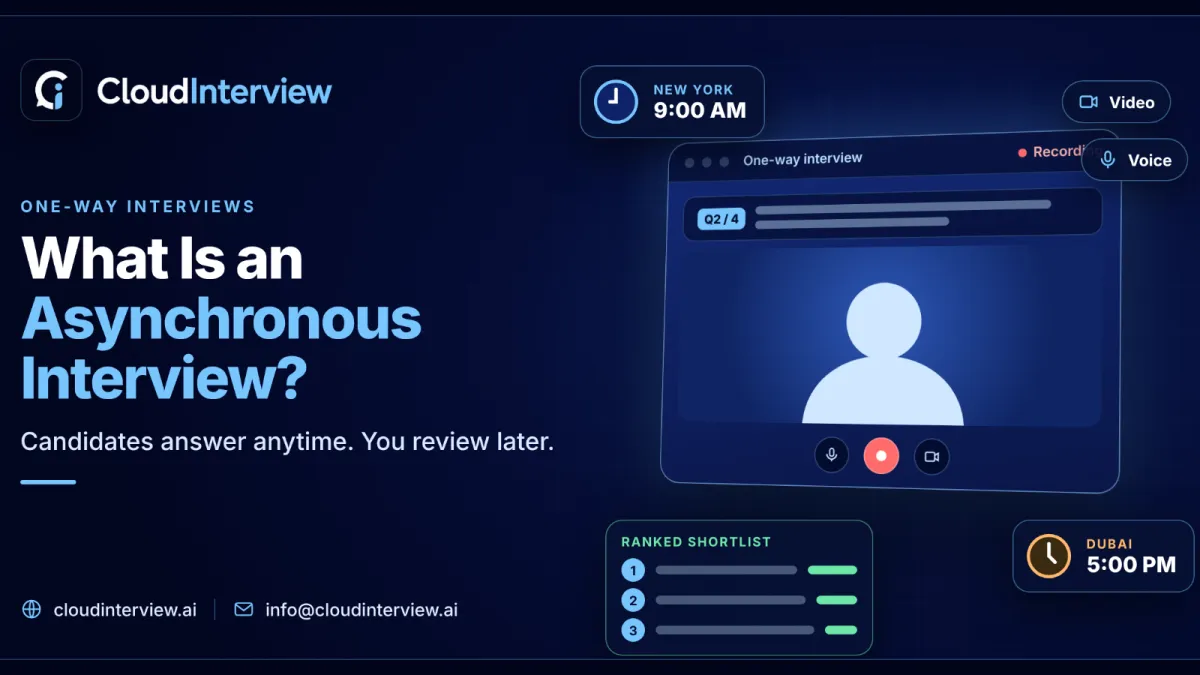
In an asynchronous interview, also called a one-way video interview, the candidate records answers to set questions at a time that suits them, and your team reviews the answers later. It works best for early screening, high-volume roles and hiring across time zones. It works badly as the only interview, for senior roles, and when candidates have no way to ask questions back.
Your best candidate might be asleep right now. When it is 9 a.m. in New York, it is 5 or 6 p.m. in Dubai, depending on the time of year. A live screening call means one of you is working outside normal hours. With an asynchronous interview, neither of you has to.
This guide covers where asynchronous interviews save real time, where they lose good people, and how to set one up so that it is fair.
Asynchronous interview at a glance
|
|
|
|
What it is |
A screening interview where the candidate answers set questions on their own time and the hiring team reviews the answers later |
|
Also called |
One-way interview, one-way video interview, on-demand interview, pre-recorded video interview, asynchronous video interview (AVI) |
|
Opposite |
Live (synchronous) interview |
|
Answer formats |
Video, voice or text |
|
Stage of hiring |
First-round screening |
|
Best for |
High-volume roles, candidates in different time zones, candidates who already have a job |
|
Not for |
Senior hires, final rounds, candidates you approached first |
|
Recommended length |
3–5 questions, about 15 minutes |
|
Main benefit |
No scheduling for the first round |
|
Main risk |
Real applicants rated it 2.40 out of 5 for fairness |
|
US rules that apply |
Illinois Artificial Intelligence Video Interview Act, Americans with Disabilities Act (ADA) |
|
Example platforms |
CloudInterview, HireVue, Spark Hire, Willo |
How does an asynchronous interview work?
An asynchronous interview is a screening interview in which the candidate and the interviewer are not present at the same time. You will also see it called a one-way interview, an on-demand interview or an asynchronous video interview (AVI). They all mean the same thing: the candidate answers now, and the team reviews later.
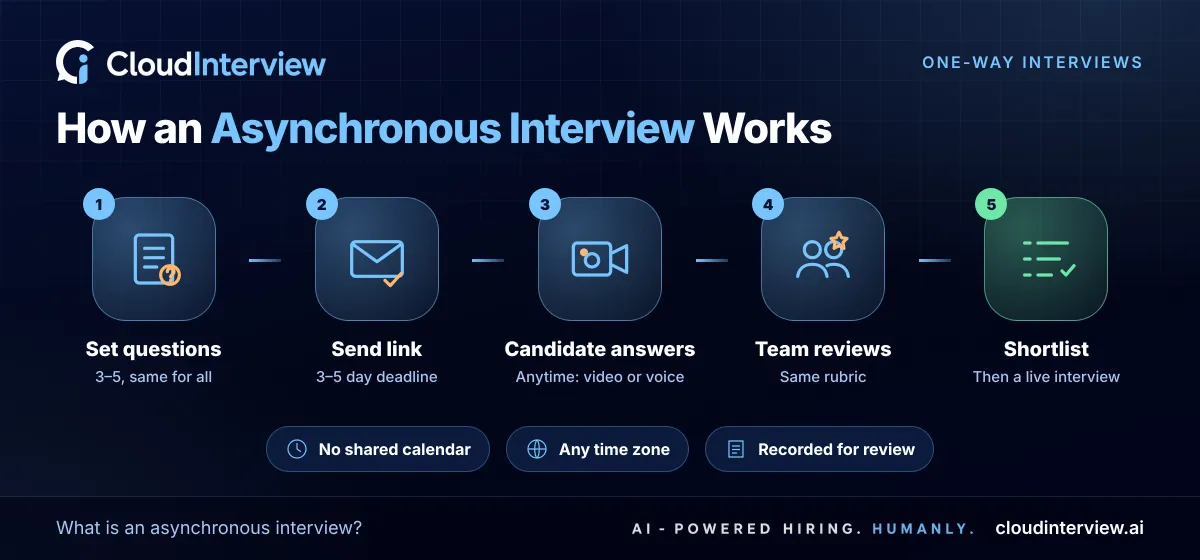
This is how it usually works:
- hiring team sets the questions and decides what a good answer looks like.
- The candidate gets a link and takes the interview whenever they choose, often within a deadline of a few days.
- The candidate answers each question by video, voice or text. Some setups add preparation time or allow a limited number of retakes.
- Reviewers score every answer against the same criteria. On AI-assisted platforms, the software produces a first score and a transcript for a person to check.
- The strongest candidates move on to a live interview.
The older version is a recorded monologue: a question appears on screen and the candidate talks to their webcam. Newer AI-led versions behave more like a conversation. On CloudInterview, for example, follow-up questions adjust to each answer, and candidates can take a voice screen through AI Calling at a time that suits them.
Asynchronous vs one-way vs on-demand interview
|
Term |
What people usually mean |
Same thing? |
|
Asynchronous interview |
Any interview where the candidate and reviewer are not live at the same time |
The umbrella term |
|
Asynchronous video interview |
The video version, where answers are recorded on camera |
Yes, video only |
|
One-way interview |
A recorded interview with no interviewer present |
Yes |
|
Pre-recorded video interview |
Another name for a one-way video interview |
Yes |
|
On-demand interview |
An interview the candidate can start whenever they choose |
Yes |
|
Live (synchronous) interview |
A real-time call or meeting with an interviewer |
No, the opposite |
What are the benefits of asynchronous interviews?
The main benefit is that you no longer need a shared calendar for the first round. That saves the most time when you hire across time zones or screen hundreds of applicants for one role.
- No scheduling back-and-forth. A live phone screen takes a booking, a reminder and often a reschedule. An asynchronous interview needs one link.
- Time zones stop mattering. A recruiter in New York and a candidate in Dubai never need to be awake at the same time.
- Employed candidates can apply. People who already have a job can interview in the evening without taking leave. These are often the candidates you most want.
- Everyone gets the same questions. Each candidate answers the same set and is scored against the same criteria. That is the core of a structured interview, and a 2022 review of selection research found that structured interviews predicted job performance better than any other method it covered.
- More than one person can review. A hiring manager can watch the same answer as the recruiter, so the decision rests on more than one first impression.
- You keep a record. Recordings, transcripts and scores show why someone moved forward. That matters when a candidate or regulator asks.
Where do asynchronous interviews fall short?
Candidates often like the idea of an asynchronous interview more than the experience of taking one. A 2019 study in the Journal of Personnel Psychology shows how large that gap can be:
|
Rating, on a 1–5 scale |
People who read a description |
Real applicants who took one |
|
How fair it felt |
3.53 |
2.40 |
|
Chance to show what they can do |
3.33 |
1.95 |
The real applicants were 103 candidates for a legal traineeship in the Netherlands, so the numbers are not universal. The direction is the warning. These are the limits that cause it:
- It is one-way. The candidate cannot ask a question, read a reaction or recover from a weak start. Many people find that talking to a camera with no one there feels cold.
- It can favour confident talkers. In the same study, more extraverted candidates felt they had a better chance to perform. A shy candidate who is excellent at the job can come across worse.
- Design choices change anxiety. A 2020 study of 223 US participants tested preparation time and retakes. Higher anxiety went with lower perceived fairness.
- Not everyone can take it the same way. A weak connection, an old phone or a disability can affect the recording. Under the ADA, employers must offer reasonable accommodations in automated assessments unless that would cause undue hardship.
- Someone else can answer. With no live interviewer, it is easier for a stand-in or a script to do the talking. Our guide to stopping fraudulent candidates covers the checks.
- AI scoring brings legal duties. In Illinois, the Artificial Intelligence Video Interview Act requires employers to tell candidates before the interview that AI may analyse the video, explain how it works, and get consent. Candidates can also ask for their videos to be deleted within 30 days.
Asynchronous vs live interviews: when should you use each?
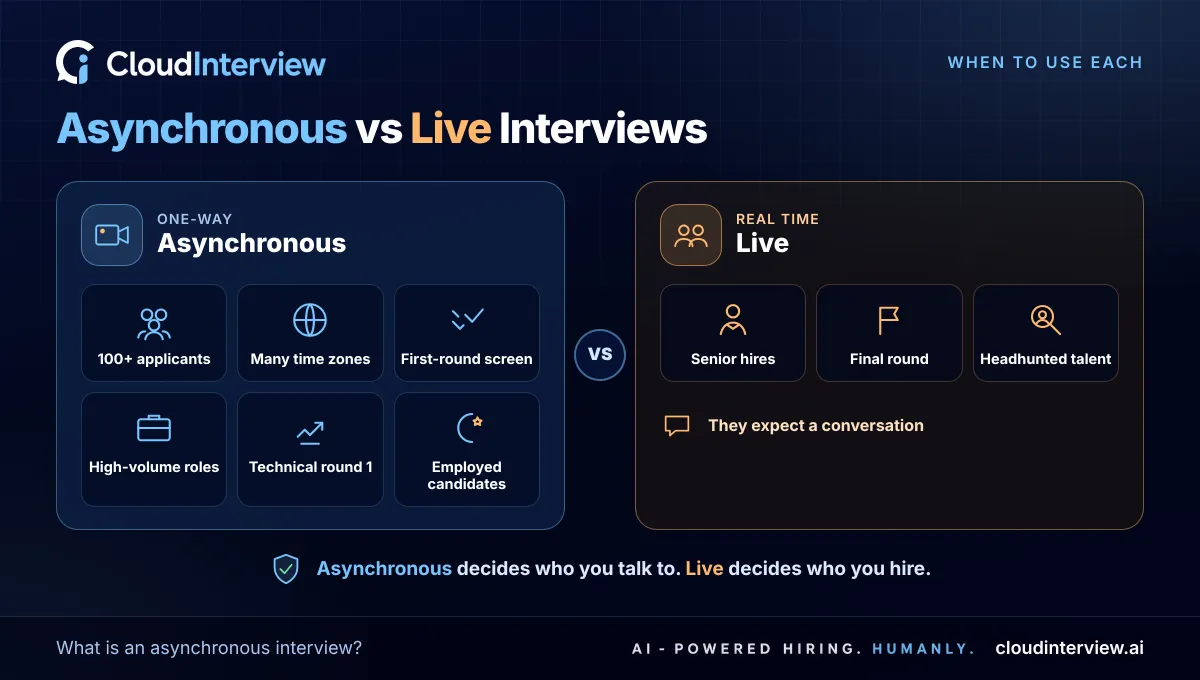
Use an asynchronous interview for the first round when volume or time zones are the problem. Use a live interview when the candidate is weighing you up as much as you are weighing them.
|
Situation |
Best format |
Why |
|
100+ applicants for one role |
Asynchronous |
You can screen all of them, not just the first 20 you have time to call |
|
Candidates spread across time zones |
Asynchronous |
No one has to interview at midnight |
|
High-volume roles such as support or sales |
Short asynchronous screen |
Fast and consistent, as long as it stays short |
|
Technical roles |
Asynchronous first round, then a live technical round |
Screen widely, then go deep with fewer people |
|
Senior and leadership hires |
Live from the start |
They expect a conversation, not a recording |
|
Candidates you approached first |
Live |
Asking someone you headhunted to record a video first is an easy way to lose them |
|
Final round |
Always live |
Candidates need to meet the people they will work with |
The rule of thumb: asynchronous interviews decide who you talk to. They should not decide who you hire.
How do you run a fair, candidate-friendly asynchronous interview?
Make it short and predictable, score only what the job needs, and keep a person in charge of every decision. These ten practices close most of the gaps above.
- Keep it short. Ask three to five questions. Every extra question is another reason for a good candidate to close the tab.
- Say what to expect before they start. Tell candidates how many questions there are, how long each answer can be, whether retakes are allowed, who reviews it and whether AI scores it. Give them a named person to email with questions, because they cannot ask during the interview. In Illinois, telling candidates about AI scoring is a legal requirement.
- Add an unscored practice question. It lets people test their camera, microphone and internet connection, and settle their nerves before anything counts.
- Decide on retakes and preparation time on purpose. Research on these settings is mixed. Pick a setting, apply it to everyone and watch your completion rate.
- Ask about the job, not the personality. Build each question from the job description, using past work and real situations from the role, such as "Tell us about a time a customer escalated a problem you could not fix."
- Write the scoring rubric first. Define what a strong, average and weak answer looks like before anyone is reviewed. Score the content, never the lighting, background, accent or appearance.
- Give a deadline that works across time zones. Three to five days gives candidates a weekend or an evening wherever they live. Send one reminder.
- Offer another format on request. Make it easy to ask for a voice, text or live option. This covers disability, poor connections and simple discomfort with cameras.
- Have a person make every rejection. AI can rank and summarise, but someone on your team should check the answers before a candidate is turned down.
- Reply to everyone. Tell candidates when they will hear back and keep that promise. A recorded interview followed by silence is the fastest way to damage your employer brand.
Handle recordings with care. Decide how long you keep them, who can watch them and how candidates can ask for deletion. See how CloudInterview handles data on our Security page.
One-way video interview invitation email template
The invitation email decides whether a candidate starts the interview at all. Tell them what it is, how long it takes, the deadline and who to contact. Copy this and edit the parts in brackets.
Subject: Next step for the [Job title] role at [Company]: a 15-minute video interview
Hi [First name],
Thanks for applying for the [Job title] role. We'd like to learn more about you through a short one-way video interview.
What it is: [4] questions about your experience and the role. You'll see each question on screen and record your answer.
Time needed: about 15 minutes, plus a practice question that isn't scored.
Deadline: [Day, date and time zone]. Take it whenever suits you before then.
Retakes: [You can re-record each answer once.]
Who reviews it: [The recruiter and the hiring manager. AI helps summarise answers, and a person makes every decision.]
[Start your interview]
If you have a question, need a different format or need more time, reply to this email or contact [Name] at [email]. We'll get back to you by [date].
Thanks, [Your name]
One-way and asynchronous video interview questions to ask candidates
Good asynchronous interview questions are short, tied to the job and possible to answer in two minutes without a follow-up. Pick three to five from this list and adapt them to the role.
To open
- Tell us about the work you do now and what you want to do next.
- What made you apply for this role?
About past work
- ell us about a time you had to learn something new quickly to finish a task. What did you do?
- Describe a mistake you made at work. How did you find it, and what did you change?
- Tell us about a time you disagreed with a teammate. How was it resolved?
About the job itself
- A customer is angry about a problem you cannot fix today. What do you say to them?
- You have three urgent tasks and time for two. How do you decide?
- Walk us through how you would approach [a real task from this role] in your first week.
Avoid questions that reward performance on camera rather than ability, such as "Sell yourself in 60 seconds". For technical roles, pair a spoken question with a short practical task.
How CloudInterview runs asynchronous interviews
CloudInterview is an AI-led asynchronous interview platform. Candidates interview by video, voice, or phone whenever they choose, and recruiters get a ranked shortlist with the reasoning behind every score.
It covers every part of an asynchronous interview:
|
What an asynchronous interview needs |
How CloudInterview does it |
|
Set questions for every candidate |
You pick the questions, or AI builds them from your job description |
|
Candidates answer on their own time |
Screening calls and interviews run around the clock, on the candidate's schedule |
|
No interviewer has to be online |
An AI interviewer runs the interview, so no recruiter has to be there |
|
The team reviews answers later |
Recruiters get a ranked shortlist with recordings, transcripts, and scores |
It also goes further than a recorded one-way interview:
- It feels like a conversation. Follow-up questions adjust to each answer, so candidates are not just talking to a camera, and a memorised script is harder to use.
- Candidates choose the format. They can take a video or voice interview, or an AI phone screen.
- Every score shows its reasoning. Each candidate is scored against the same rubric, and your team can see why. Your team still decides who moves forward.
- Multiple languages. Candidates can interview in their own language and accent.