Your Background Check Passed. So Who Showed Up on Day One?
Your background check verified a real person. But was it the one you interviewed? Here's the identity gap in hiring and how to close it.
Here's a situation more U.S. employers are running into.
You interview a great candidate. The background check comes back clean. Their I-9 documents check out. E-Verify confirms them. Then on day one, the person who logs in can't do half of what they talked about in the interview.
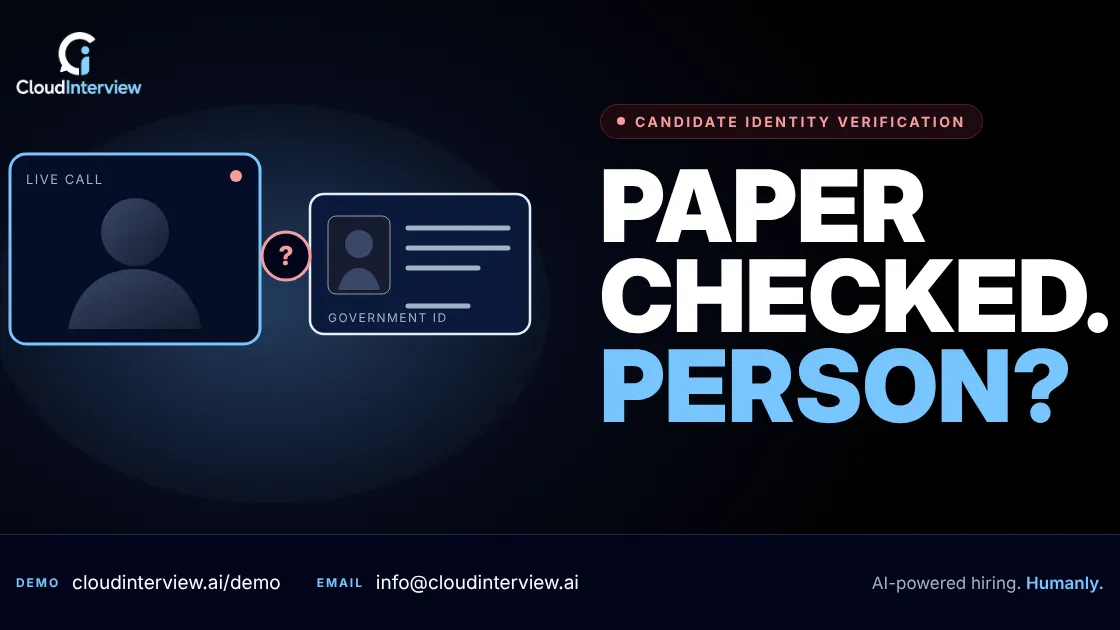
What happened? Every check you ran was looking at paperwork. None of them checked that the person you interviewed is the person you hired. That's the gap, and it's exactly where hiring fraud gets through.
This guide shows you where that gap is, how to spot warning signs, and what to say to candidates so honest people don't feel accused. It's written for small and growing teams, not big companies with a security department.
In this guide
- A real-world example: how "Alex" got hired
- Paperwork checks vs people checks
- The identity drift scorecard
- What to say to candidates
- What U.S. rules allow, and when
- Where CloudInterview helps
- FAQs
A real-world example: how "Alex" got hired
This is a made-up example, but it's based on patterns the FBI described in its October 2026 warning about North Korean IT workers.
A 40-person software company is hiring a remote backend developer. "Alex" applies.
| Step | What the company checked | What it missed |
|---|---|---|
| Application | A strong LinkedIn-style profile with years of history | The profile belonged to a real engineer, not the person applying |
| First screen | Clear, confident answers | Nobody compared this voice with later rounds |
| Technical interview | Excellent answers | A different, more skilled person showed up for this round |
| Offer and background check | A clean history for the name given | The history was real. It just wasn't the person they interviewed |
| Day one | Valid I-9 documents | Nobody compared the new hire with the interview recordings |
Every single check passed. The company still hired someone it never really interviewed.
The FBI says this is happening. People are being paid to "take interviews or attend meetings on someone's behalf," and fake candidates are borrowing real people's online profiles.
Paperwork checks vs people checks
Think of candidate identity verification in two parts:
- Paperwork checks make sure the documents and records are real.
- People checks make sure the same human shows up at every step.
Most companies only do the first kind.
| Check | Checks the paperwork? | Checks the person? |
|---|---|---|
| Background check | Yes, real history for that name | No |
| Form I-9 and E-Verify | Yes, documents match records | Only at that one moment |
| Live ID check with finalists | Yes | Yes, at that moment |
| Recorded interviews | No | Yes, if someone compares them |
| Follow-up questions across rounds | No | Yes |
You need both. Paperwork checks stop fake documents. People checks stop the swap.
The identity drift scorecard
"Identity drift" just means small details about a candidate change from one step to the next. One change usually has an innocent reason. A bad Wi-Fi day happens. But when several things change, it's worth a closer look before you make an offer.
Score each one: 0 = no change, 1 = small change with a clear reason, 2 = change nobody can explain.
| What to watch | How to check it | Score (0–2) |
|---|---|---|
| Face and voice | Compare interview recordings | |
| How deep their answers go | Can they build on what they said last round? | |
| Camera habits | On for easy questions, off for hard ones? | |
| Contact details | Phone, email and time zone match across steps? | |
| Profile match | Do they know the details of work on their profile? | |
| Shipping and pay details | New address or bank info right after the offer? |
What your total means:
- 0–2: Move ahead as normal.
- 3–5: Add one more live interview with someone who knows the role before you make an offer.
- 6 or more: Pause. Do a live identity check and loop in HR and IT.
One important rule: use the scorecard for every finalist, not just people who "seem off." The FBI warns that filtering people by name or nationality doesn't work and can hurt real victims of identity theft.
What to say to candidates
Most candidates are honest. How you ask matters. These scripts make checks sound normal, because they are.
In your interview invite:
"We record every interview round so everyone is judged on the same thing. Each round builds on the last one, so please join each round yourself with your camera on."
At the start of a later round:
"Last time you mentioned [a specific detail]. I'd love to hear more. What happened next?"
If their camera stops working during the technical part:
"No problem. Let's reschedule the technical part on video so you get a fair shot to show your work."
Before making offers:
"Before we make offers, we do a quick live identity check with all our finalists. It takes about five minutes."
If a detail changes:
"We noticed your phone number changed since you applied. Could you confirm the best number by email so our records are right?"
What U.S. rules allow, and when
Quick summary, not legal advice:
- Background checks: The FTC says you need to give a separate written notice (not buried in the application), get written permission, and confirm this to the background-check company. If you plan to turn someone down because of the report, give them a copy and a summary of their rights first.
- Form I-9: The new hire picks which approved documents to show you. The U.S. Department of Justice says employers can't ask for specific documents, like "bring your passport."
- E-Verify: It starts after Form I-9 is done, and you have until the third business day after they start work for pay. You can't use it before the person accepts the job offer.
- Live ID checks before the offer: Many employers use an identity-verification provider for finalists. Do it the same way for everyone, and check with your lawyer how it fits with I-9 and anti-discrimination rules.
Where CloudInterview helps
CloudInterview doesn't do background checks or ID verification. It helps with the people-check side, during interviews.
AI Interviews record every candidate and save scores and transcripts, so you have something to compare later rounds and day one against. Interview Outsourcing adds a recorded live interview with an expert in the role. That's the step a stand-in finds hardest to fake. Want to see how stand-ins slip through? Read Proxy Interview: 5 Gaps Where Stand-Ins Slip Through.
AI for scale. Human experts for judgment.
Check the person, not just the paperwork
Background checks, Form I-9 and E-Verify all matter. But they check paperwork. Add a few simple people checks to your interviews, use the scorecard the same way for everyone, and you'll close the gap most hiring fraud slips through.
Book a demo to see how CloudInterview records every interview round and adds a live expert interview before you hire. AI-powered hiring. Humanly.