AI Candidate Screening: How It Works and What to Check Before You Buy
AI candidate screening gives every applicant the same first-round screen and recruiters a ranked shortlist. Here's how it works and how to test it in 2 weeks.
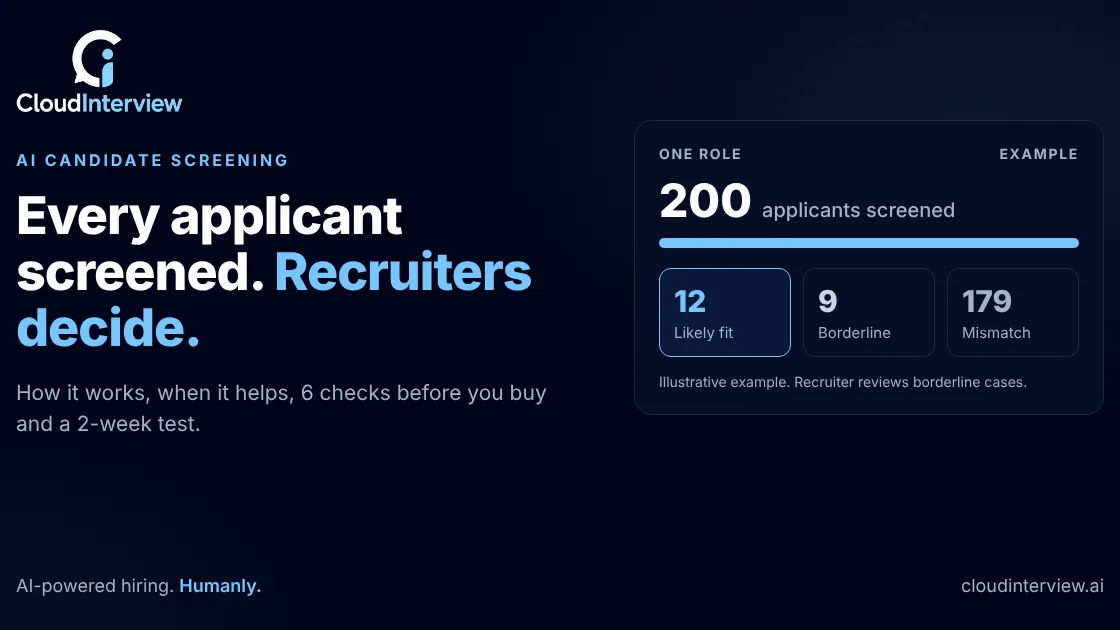
AI candidate screening is the use of AI to give every applicant the same first-round screen (usually a phone call or short interview), score their answers against criteria your team sets, and hand recruiters a ranked list with the evidence behind it. The recruiter still decides who moves forward.
For teams hiring at volume, it replaces the slowest part of hiring: dozens of 15-minute first calls that mostly confirm basics.
In this guide
- Why recruiters are switching to AI screening
- How AI candidate screening works
- When AI screening helps, and when it doesn't
- 6 checks before you buy AI screening software
- A 2-week way to prove it works
- How CloudInterview approaches AI candidate screening
- FAQ
Why recruiters are switching to AI screening
A single job post can bring in 200 applicants. A recruiter can make maybe 25–30 first calls a day. Everyone else waits, and the strongest candidates often accept another offer before you reach them.
AI screening changes the order of work:
- Every applicant is contacted, not just the first 30.
- Every applicant hears the same questions, so comparisons are fair.
- Recruiters start their day with a ranked list and transcripts, not a call sheet.
How AI candidate screening works
- You set the criteria. List the 3–5 must-haves for the role, such as shift availability, required certification or years with a specific tool.
- The AI runs the screen. Candidates take a short AI phone screening call or interview at a time that suits them, around the clock.
- Answers are captured. Each conversation is recorded and transcribed.
- Candidates are ranked. Answers are compared against your criteria, and candidates are grouped into likely fits, borderline cases and clear mismatches.
- A recruiter reviews. Recruiters read transcripts for the borderline group and call the strongest candidates first.
When AI screening helps, and when it doesn't
It helps when:
- You get 50+ applicants per role
- Roles repeat often (support, sales, operations, junior engineering)
- Candidates sit in different time zones
- Response time matters, because good candidates disappear in days
Keep humans in charge when:
- The role is senior and the first conversation is also a sales pitch for the job
- You only receive a handful of applicants
- The decision needs judgment the criteria can't capture, such as team fit
6 checks before you buy AI screening software
- Can you write the questions? Avoid tools that lock you into a generic question bank.
- Can you read or hear every answer? A score without a transcript is a black box you can't defend.
- Does it score against your criteria? Ranking should follow the must-haves you set for the role.
- Is there a human review step? No candidate should be rejected automatically without someone checking borderline cases.
- How does it feel for candidates? Test it yourself: is it clear, short and mobile-friendly?
- Will the vendor test it on your role? Ask for a demo using one of your real job descriptions, not a sample role.
A 2-week way to prove it works
Run one open role through AI screening alongside your normal process:
- Week 1: Screen every applicant with AI. Have your recruiter shortlist from the same pool as usual.
- Week 2: Compare the two shortlists. How much do they overlap? How many hours did the recruiter save? How many candidates finished the screen?
If the AI shortlist matches your recruiter's judgment and saves real hours, expand to more roles.
How CloudInterview approaches AI candidate screening
CloudInterview runs AI phone screening with role-specific questions, transcripts and ranked results, so recruiters only follow up with qualified candidates. For roles that need more depth, conversational AI interviews ask adaptive follow-up questions, and expert interviewers can run technical rounds on your rubric. Hiring teams review real answers and decide.
See CloudInterview AI phone screening · Start a free trial · Book a demo