Candidate Assessment Tools: Which One to Use at Each Hiring Stage
Most teams use one candidate assessment tool for everything. Here's which tool belongs at each hiring stage, and which ones AI answer tools can beat.
Most teams pick one candidate assessment tool and use it for everything. A skills test becomes the screen, the shortlist and the final check. That made sense when a test was hard to fake. In 2026, an AI answer tool can complete many unproctored tests in minutes, so the better question is not "which tool?" but "which tool at which stage?"
This guide compares 6 types of candidate assessment tools, shows which ones still hold up against AI-assisted answers, and gives you a ready-made assessment stack for common IT and non-IT roles.
In this guide
- What candidate assessment tools are
- 6 types of candidate assessment tools compared
- The AI-assistant problem
- Build your assessment stack by stage
- Assessment stacks for common roles
- Check adverse impact before you trust any score
- 7 questions to ask an assessment vendor
- Where CloudInterview fits
- FAQs
What candidate assessment tools are
Candidate assessment tools are any method you use to measure whether an applicant can do the job, beyond reading their resume. They fall into two families. Test-based tools ask candidates to complete a task or questionnaire on their own. Interview-based tools assess candidates through a conversation, recorded or live.
6 types of candidate assessment tools compared
| Tool type | Best at measuring | Weak spot |
|---|---|---|
| Skills tests (multiple choice, knowledge quizzes) | Baseline knowledge, fast | Easy to answer with AI tools when unproctored |
| Behavioral and personality assessments | Work style, preferences | Self-reported; says little about job skills |
| Work samples and take-home tasks | Real output on a realistic task | Can't confirm who did the work |
| One-way video interviews | Communication on fixed questions | No follow-up questions |
| Conversational AI interviews | Reasoning, with follow-ups at scale | Needs clear criteria per role |
| Live expert interviews | Deep technical or specialist judgment | Costs expert time, so used late |
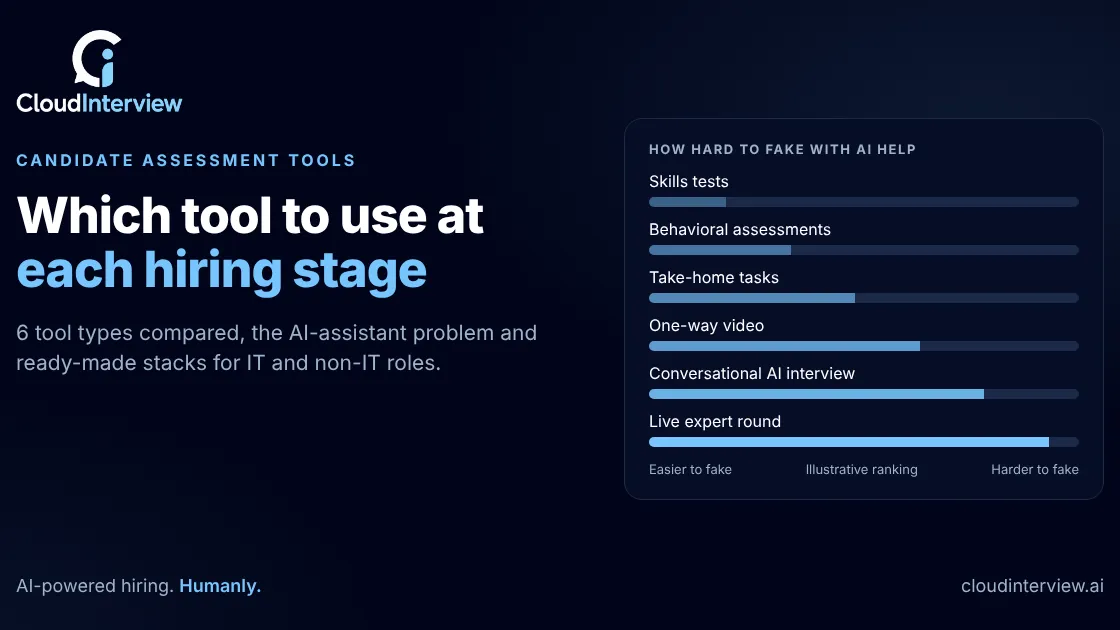
The pattern: tools that test what a candidate knows are cheap and fast but easier to game. Tools that test how a candidate thinks take more effort but are harder to fake.
The AI-assistant problem
Any unproctored assessment that has a "right answer" can now be completed with help from an AI tool. That includes many skills quizzes, written answers and take-home tasks. Proctoring helps, but a tool running on a second device is hard to spot.
What still holds up is a follow-up question that depends on the candidate's own earlier answer. A helper can supply an answer to a known question. It struggles to defend that answer when the next question changes the constraints. That is why conversation-based stages, AI-led or live, are becoming the checkpoint that matters. For how stand-ins get through between rounds, see Proxy Interview: 5 Gaps Where Stand-Ins Slip Through.
Build your assessment stack by stage
Use each candidate assessment tool where it is strongest, and stop it from doing a job it can't do.
- Screen (every applicant): confirm must-haves such as availability, location and required certifications. Use AI candidate screening or a short knock-out form.
- Skills (the top 20–30%): test the core skill with follow-ups. Use a conversational AI interview or a short work sample discussed afterwards.
- Depth (the shortlist): confirm judgment with a specialist. Use a live expert round scored on a structured scorecard.
- Final (2–3 candidates): team fit and the offer conversation. Keep this in-house.
Small teams rarely need more than 3 tools. Each extra tool adds a step where candidates drop out.
Assessment stacks for common roles
| Role | Recommended stack | Why |
|---|---|---|
| Customer support | AI phone screen → AI interview with scenario follow-ups → manager call | Tone and problem-solving show in follow-ups, not quizzes |
| Sales | AI phone screen → AI interview with an objection role-play → manager call | Handling pushback is the job |
| Retail and hourly roles | AI phone screen for availability → short in-person trial | Speed matters more than depth |
| Software engineer | AI interview with technical follow-ups → live expert technical round → team round | Expert depth confirms the AI round |
| Data analyst | Short work sample → AI interview discussing the sample → expert round | Discussing their own work confirms who did it |
Check adverse impact before you trust any score
Every candidate assessment tool produces pass rates. Compare them across groups. Under the U.S. Uniform Guidelines on Employee Selection Procedures, a selection rate for any race, sex or ethnic group that is less than four-fifths (80%) of the rate for the highest group is generally regarded as evidence of adverse impact.
A simple example: if 50% of one group passes an assessment and 35% of another group passes, the ratio is 35 ÷ 50 = 70%. That is below 80%, so the assessment needs a closer look before you rely on it. In New York City, automated tools used in hiring also need a bias audit under Local Law 144. This is a summary, not legal advice.
7 questions to ask an assessment vendor
- What exactly does it measure, and how is that linked to job performance?
- Can candidates complete it with an AI tool? What stops that?
- Does it ask follow-up questions, or only fixed ones?
- Can I see the evidence behind every score, such as answers, transcripts or recordings?
- Can you share pass-rate data by group, or a bias audit summary?
- How long does it take candidates, and what is the completion rate?
- How is it priced? Per candidate, per interview or an annual seat?
Where CloudInterview fits
CloudInterview covers the interview-based stages of the stack, not psychometric testing. AI Calling screens every applicant with role-specific questions and transcripts. AI Interviews ask adaptive follow-up questions and give your team scores, transcripts, recordings and reasoning, plus a ranked shortlist. Interview Outsourcing adds a recorded, rubric-based round with a matched expert for roles that need specialist judgment.
AI for scale. Human experts for judgment.
Use the right tool at the right stage
Tests are good at speed. Conversations are good at truth. Put each candidate assessment tool where it is strongest, and add follow-up questions wherever the answer could be faked.
Book a demo to see how CloudInterview runs the screening and interview stages of your assessment stack. AI-powered hiring. Humanly.