How Do AI Interviews Work? Employer Guide
Understand the AI interview process from role setup and candidate questions to scoring, review, and a final hiring decision.
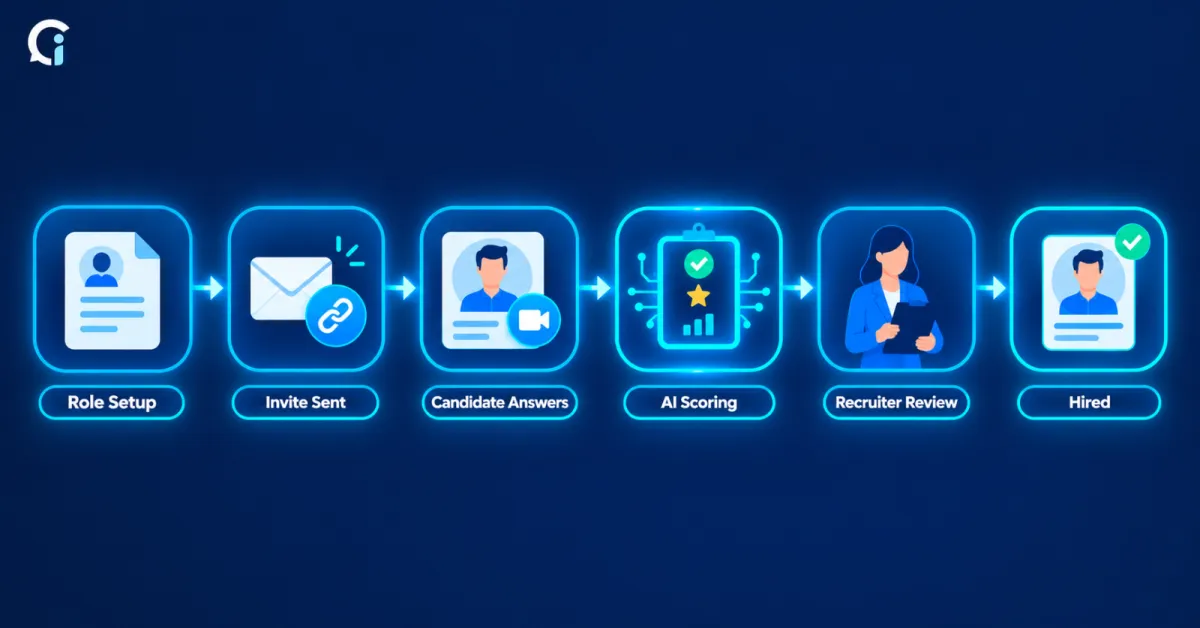
An AI interview platform takes the requirements of a role, translates those into a set of structured questions, asks the candidate to respond by video, voice or text, then scores those answers against a rubric and presents evidence to a recruiter to help them make a hiring decision.
The AI runs the interview and generates a scorecard – a human makes the hiring decision.
Here's how that works, step-by-step.
1. The role is defined
Someone on the hiring team inputs the job description, or the platform uses it to generate questions. This step determines what "good" means for a particular role: the skills needed to perform the job, the logistics (location, shift, language) that are a dealbreaker, and the behaviors the employer is looking for.
This step determines whether the entire process is even worth doing. A generic set of questions results in a generic set of answers.
2. Candidate gets an interview link
Candidates get a link, and complete the interview on their own time, usually with a deadline in mind. No need to coordinate calendars across time zones, no back-and-forth to set up a call.
3. Candidate answers structured questions
The candidate answers the questions by video, voice or text, depending on what the platform and the role allow. Every candidate for the role answers the same questions, in the same order.
4. The AI scores the candidate's answers
The platform evaluates the answers according to the criteria defined in step 1: does this answer demonstrate the required skill, does it meet a logistics requirement, does it reflect the tone the employer is looking for? The result is a score for each answer and the overall scorecard.
5. The recruiter reviews the evidence
The recruiter sees a ranked set of candidates with scores, a summary, and the full transcript or recording of the interview, to understand how the score was determined.
This is where a recruiter spot checks: did this candidate get a high score but not the right qualifications, or a low score but impressive answers? At this point in the process, the evidence is there, easily reviewable.
6. A human makes the decision
The AI has done its job, by narrowing the field and presenting evidence to the recruiter. The hiring manager or recruiter decides which candidate to advance to the next step in the process. No algorithm makes the final offer or rejection.
What this replaces, and what it doesn't
| Stage | Before | With AI interviews |
|---|---|---|
| First-round scheduling | Coordinating calendars across time zones | Candidate answers on their own time |
| First-round evaluation | Recruiter listens/watches one at a time | Every candidate scored with same rubric |
| Evidence for a decision | One person's notes or recollection | Transcript, recording and score |
| Final decision | Recruiter or hiring manager | Still the recruiter or hiring manager |
Is it secure?
Candidate answers, video, and transcripts are all sensitive data, which is why you should ask any vendor how they back that up, who has access, and how long it's retained. See our security page for CloudInterview's policies on this.
Ready to see it in practice? See how AI interviews work or learn more about CloudInterview.