AI Phone Screening vs Manual Recruiter Calls
Compare AI phone screening with recruiter calls across speed, consistency, candidate experience, cost, and human oversight.
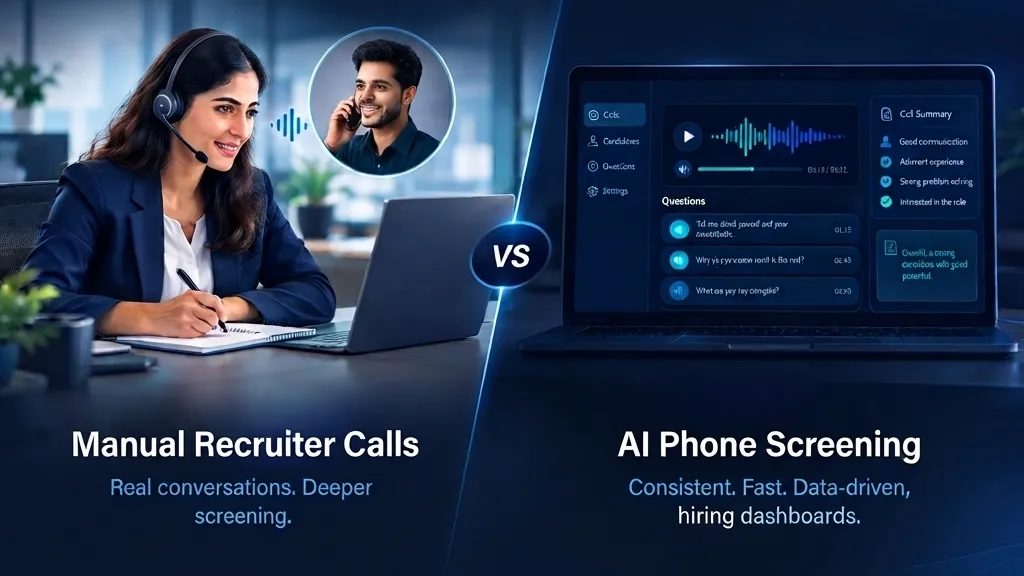
AI Phone Screening vs Manual Recruiter Calls: What Changes?
The first screening call helps a hiring team answer a practical question: should this candidate move to the next stage? It is also an opportunity for candidates to understand the role and decide whether it interests them.
Recruiters often repeat the same introductory questions across these calls. AI phone screening can automate parts of that conversation, but choosing between automation and a recruiter involves more than speed.
Here is how the two approaches compare across consistency, candidate experience, cost, and human oversight.
What is AI phone screening?
AI phone screening uses a voice-based system to conduct an initial conversation with a candidate. Depending on the platform and configuration, it can ask predefined questions, capture answers, and prepare information for a recruiter to review.
A candidate pre-screening call might cover relevant experience, availability, preferred work location, or essential role requirements.
In a manual call, the recruiter asks the questions, explores the answers, and records their assessment. The recruiter can also explain the opportunity and respond to concerns as they arise.
AI phone screening vs manual calls at a glance
| Area | AI phone screening | Manual recruiter calls |
|---|---|---|
| Speed | Can reduce recruiter time spent conducting repetitive calls | Requires recruiter availability for each conversation |
| Consistency | Can follow a configured question set across calls | Depends on how closely recruiters follow a shared structure |
| Candidate experience | Depends on voice quality, clarity, flexibility, and access to human help | Allows immediate clarification and personal interaction |
| Cost | Includes platform fees, setup, integration, and review time | Includes calling, scheduling, note-taking, and follow-up time |
| Human oversight | Requires a clear process for reviewing outputs and handling exceptions | Recruiter directly interprets answers during the call |
1. Speed: conducting calls and reviewing them are different tasks
When many candidates apply for similar roles, repeating basic screening questions can take up a substantial part of a recruiter’s day.
Automated phone screening can reduce that calling workload. Where a platform supports the necessary capacity and scheduling, it may also help teams reach candidates sooner.
However, a completed call still needs to produce useful information. Recruiters may need to check unclear answers, correct transcripts, or arrange another conversation.
Evaluate the time from application to a reviewed screening outcome—not just the number of calls completed.
2. Consistency: the screening structure matters
AI screening calls can follow a common set of questions, helping teams collect comparable information.
Manual calls can achieve this too. The U.S. Office of Personnel Management describes structured interviews as using predetermined questions and common rating standards across candidates. Consistency comes from the design of the process, whether a person or a system asks the questions.
Before automating, define what each question should establish and how answers will be evaluated. A consistent script alone does not guarantee a fair or accurate assessment.
3. Candidate experience: convenience and conversation both count
An automated call may suit a candidate who wants to complete a short screening step without arranging time with a recruiter.
Others may want to discuss the team, clarify an unusual career path, or ask detailed questions about the position. A recruiter can respond to that context and adapt the conversation.
When evaluating AI phone screening, test how it handles interruptions, requests to repeat a question, unclear audio, and unexpected answers. Explain the process to candidates and provide a straightforward way to reach a person.
4. Cost: compare the complete workflow
Manual screening costs include more than the conversation itself. Scheduling, unsuccessful call attempts, notes, and follow-ups also require time.
AI screening introduces a different set of costs: platform charges, configuration, integration, recruiter review, and any calls that need to be repeated.
A useful comparison is:
Cost per usable screening = total screening costs ÷ screenings completed with enough information for review
Run a limited pilot using similar roles and candidate volumes. Compare costs alongside completion rates, candidate feedback, and the quality of information recruiters receive.
5. Human oversight: decide who reviews and acts
Automation should have a clearly defined role in the hiring process. Teams need to establish who checks screening outputs, resolves uncertainty, and decides what happens next.
NIST’s AI Risk Management Framework highlights ongoing monitoring and human intervention where systems cannot detect or correct errors. That principle is relevant when evaluating automated screening outputs.
A practical workflow is to use automation for an initial information-gathering step, then have recruiters review the responses and handle conversations that need more context.
Which approach fits your hiring process?
AI phone screening is worth evaluating when your team handles repeated introductory questions across a large applicant pool.
Manual calls may be more suitable when the first conversation requires detailed explanation, relationship-building, or substantial follow-up.
You can also combine the approaches: automate a clearly defined first step and retain recruiter conversations where they add the most value.
Explore CloudInterview’s AI Calling to assess how it could fit your screening workflow.