AI Candidate Screening for High-Volume Hiring
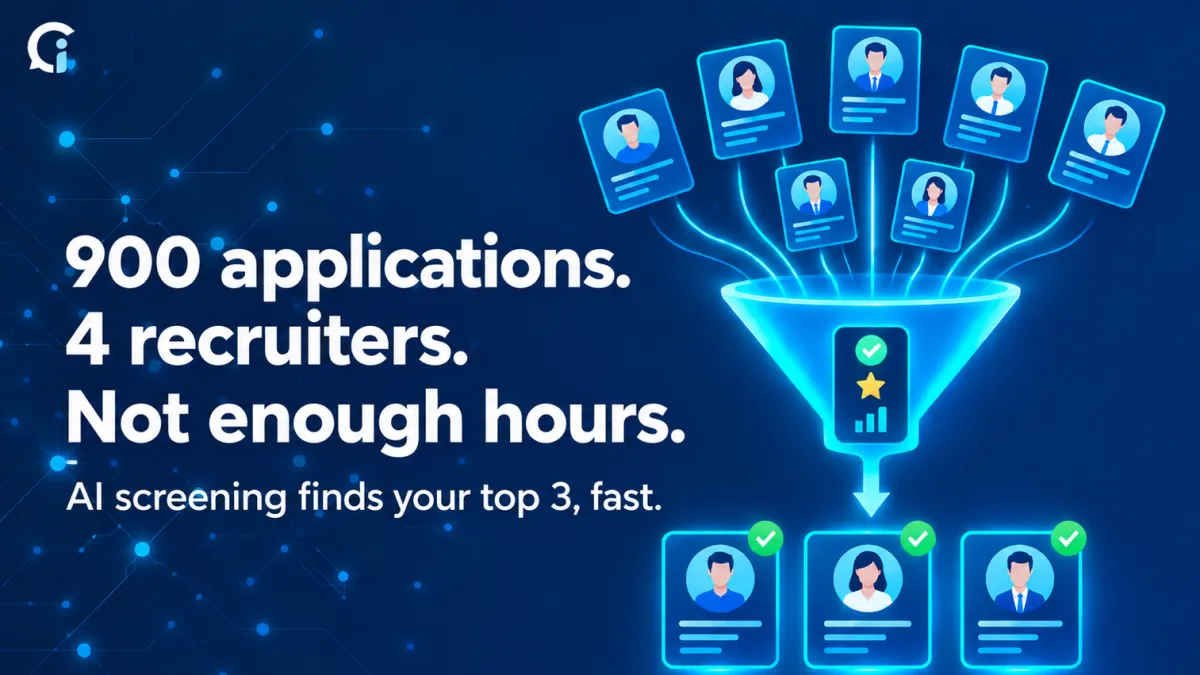
900 applications, four recruiters, no calls made by Friday. See how AI candidate screening gives every applicant a consistent, reviewable first look.
How AI Candidate Screening Improves High-Volume Hiring
Imagine a four-person talent team in need of customer support agents. The opening goes up on Monday. By Friday, there are 900 applications, and the first call to a candidate hasn't happened yet.
The problem isn't finding candidates but processing this volume. Manual screening is a recipe for predictable outcomes:
- The first 100 applications get a detailed review, and the last 400 get a superficial one
- Strong candidates who describe their experience differently get filtered out
- The best applicants take another offer while waiting for a callback
AI candidate screening solves this problem by providing a consistent initial evaluation and a structured review for every applicant, giving your team a manageable set of candidates to work with.
What actually changes
| Manual screening | Structured AI screening |
|---|---|
| Recruiter reads a resume, makes a snap decision | Every applicant answers the same role-specific questions |
| Candidate #12 and #600 receive different attention | Same questions and scoring criteria apply to everyone |
| Notes stay in a recruiter's head or a spreadsheet | Transcripts, scores, and a summary are created per candidate |
| Candidates wait for a callback slot | Candidates respond on their terms, in their language |
The benefits extend beyond speed and consistency.
A screening rubric for one role
Any screening process is only as good as the rubric it uses. For the support-agent opening, it might look like this:
| Signal | Example question | Strong answer looks like | Weak answer looks like |
|---|---|---|---|
| Handling frustration | "A customer says they've been charged twice and is angry. What do you do first?" | Acknowledges the issue, verifies details, states next steps | Blames the customer or jumps to a policy |
| Written/spoken clarity | "Explain how to reset a password to someone who isn't technical." | Simple ordered steps, checks understanding | Jargon, skipped steps |
| Reliability | "Tell me about a time you had to cover a shift or deadline at short notice." | A specific situation and what they did | Vague or hypothetical |
| Role logistics | Shift availability, language, start date | Clear answers | Conflicts with must-haves |
Two observations: the questions ask about the role-specific skills, not standard competency interviews, and every signal has specific criteria to score applicants consistently. When you set up a role in CloudInterview, you start with the job description and modify the questions and criteria from there.
What the recruiter sees at review
There is no way to review 900 transcripts. Instead, the review should be a prioritized list with each candidate having:
- an overall score against the rubric (with the score for each signal), a
- brief summary of the answers, and
- the full transcript and recording, one click away to verify
The recruiter reviews the top candidates, confirming the reasoning, and advances them to the human interview. The others aren't discarded: the recruiter works with the next priority batch, and can always go back if needed.
Where it goes wrong
Most articles miss this section. Here are the common pitfalls:
| Risk | What to do |
|---|---|
| The rubric favors articulate candidates | Score the substance of the answer, not the delivery. Test the rubric against a few known good and average employees. |
| Non-native speakers or unusual accents are penalized | Hold multilingual options open, and consider score patterns across language groups. |
| Candidates use an assistant or another person to answer | Use integrity checks and probe deeper in the human interview with a follow-up question. |
| Team trusts the score blindly | Have a human on every advance/reject decision, and sample the low-scoring group on a regular basis. |
| The rubric becomes outdated | Compare it against actual performers once in a while |
If your team can't explain to you why a candidate got a high score, this process isn't ready for high-volume screening.
A simple rollout
- Pick one high-volume role to start with. The one that hurts the most.
- Write the rubric, then the questions.
- Run it alongside the current process for the next batch and compare the shortlists
- Update the rubric where it disagrees with your current process, then use it exclusively
How CloudInterview fits
CloudInterview allows teams to run AI interviews and AI screening calls against a role description, with scoring, transcripts, recordings and evaluation reports for each candidate. Looking to hire an agency rather than in-house resources? We have a high-volume staffing playbook.
Ready to try structured screening on your busiest role? Explore AI screening or start your free trial.